GUIDE Effects
MPC EQ effects: same four bands, three different tools
The EQ/Filter category's own effects list names sixteen entries, and three of them are full parametric equalizers built around the same four-band idea: AIR Para EQ, PEQ 2-Band (2-Shelf), and PEQ 4-Band. They don't behave the same. AIR Para EQ can flip its two outer bands between a flat shelf and a single peaked bell, with the Q and Gain range changing depending on which one you pick. PEQ 4-Band shares byte-identical frequency fields with PEQ 2-Band but has no shelf option anywhere, every band is a fixed bell. Checked page by page against Akai's own manual, not summarized from a catalog list.
The short version
This site's own insert vs send/return effects article already counted the EQ/Filter category's size and this site's compressor effects article covered the Dynamics category the same way. EQ/Filter is bigger, sixteen named effects, and only three of them are full-featured parametric equalizers rather than a single static filter or an LFO-modulated sweep:
"Options: AIR Enhancer, AIR Filter Gate, AIR Filter, AIR Kill EQ, AIR Para EQ, AIR Vintage Filter, HP Filter Sweep, HP Filter Sync, HP Filter, HP Shelving Filter, LP Filter Sweep, LP Filter Sync, LP Filter, LP Shelving Filter, PEQ 2-Band, 2-Shelf, PEQ 4-Band"
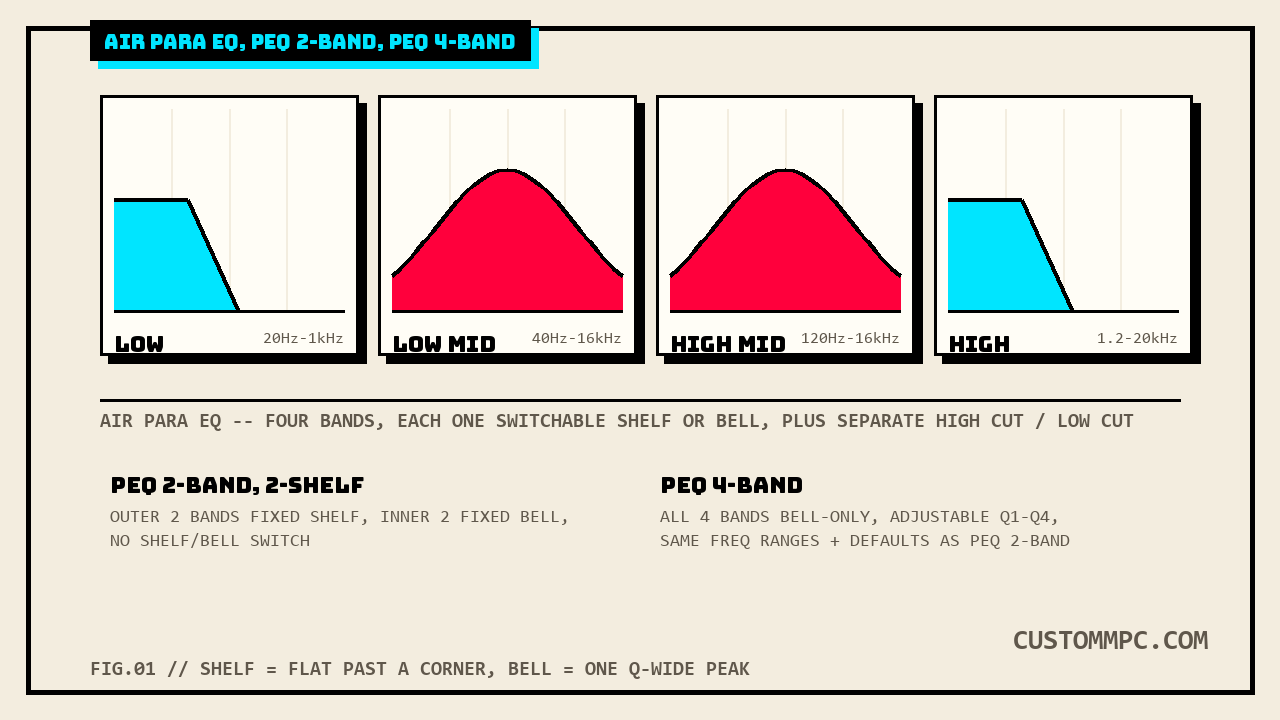
AIR Para EQ is the most flexible of the three: four bands, and the two outer ones (Low, High) carry their own Type switch between Shelf and Bell, with the available Q and Gain range changing depending on which one is active. PEQ 2-Band, 2-Shelf fixes that same four-band idea permanently, outer two locked to shelf, inner two locked to bell, no switch. PEQ 4-Band drops the shelf option entirely and makes all four bands adjustable-Q bells, while quietly sharing PEQ 2-Band's exact frequency range and default numbers on all four slots.
Where these live: the EQ/Filter category
Same shared effects list this site has already mapped twice, one insert-or-send/return catalog, 98 effects across six categories. EQ/Filter is the largest of the six at sixteen entries, more than double Dynamics' fourteen:
"Every insert or send/return slot, regardless of location, pulls from the same shared list: 98 individual effects split across 6 categories in Akai's own Effects & Parameters appendix."
That means every EQ covered here loads the same way any other insert or send/return effect does, no separate EQ-only workflow, same four insert slots per track or shared four-slot return bus as everything else in the catalog.
AIR Para EQ: four bands, two of them switchable
Akai's own description leads with the feature that sets it apart from the other two:
"This effect is a powerful four-band parametric equalizer with four independent EQ ranges, adjustable Low and High EQ filter types, and dedicated Low Cut and High Cut."
Only the two outer bands, Low and High, carry a Type field. The two inner bands, Low Mid and High Mid, have no Type field at all, they're fixed parametric bells with no shelf option ever offered:
| Band | Freq range | Default | Q range | Gain range | Type |
|---|---|---|---|---|---|
| Low | 20.0 Hz – 1.00 kHz | 100 Hz | Shelf 0.40–2.00 / Bell 0.40–10.00 | Shelf ±12.0 dB / Bell ±18.0 dB | Shelf, Bell (default Shelf) |
| Low Mid | 40.0 Hz – 16.00 kHz | 247 Hz | 0.40–10.00 | ±18.0 dB | Bell only, no Type field |
| High Mid | 120 Hz – 16.0 kHz | 2.00 kHz | 0.40–10.00 | ±18.0 dB | Bell only, no Type field |
| High | 1.2 – 20.0 kHz | 6.00 kHz | Shelf 0.40–2.00 / Bell 0.40–10.00 | Shelf ±12.0 dB / Bell ±18.0 dB | Shelf, Bell (default Shelf) |
Every band also carries its own Out/In toggle, four independent on/off switches inside one effect, and the whole thing adds a separate Output trim (−20.0 to +20.0 dB) plus two more filters that aren't part of the four bands at all:
| Parameter | Range | Default |
|---|---|---|
| Output | −20.0 to +20.0 dB | 0.0 dB |
| High Cut Freq | 120 Hz – 20.0 kHz | 20.0 kHz |
| High Cut Type | 6, 12, 18, 24 dB/oct | 12 dB |
| Low Cut Freq | 20.0 Hz – 8.00 kHz | 100 Hz |
| Low Cut Type | 6, 12, 18, 24 dB/oct | 12 dB |
Flip Low's Type from Shelf to Bell and two things change at once, not just the curve shape: the Q range widens from a maximum of 2.00 to a maximum of 10.00, and the Gain range widens from ±12.0 dB to ±18.0 dB. A shelf pushed to its ceiling and a bell pushed to its ceiling on the exact same band aren't reaching the same loudness, the bell goes six decibels further in either direction.
PEQ 2-Band, 2-Shelf: a fixed topology
Where AIR Para EQ lets you choose the shape per band, PEQ 2-Band bakes the choice in at the effect level, right there in its own name:
"This effect is a combination of one two-band parametric equalizer and two shelving filters."
| Parameter | Range | Default |
|---|---|---|
| Low Frequency (shelf) | 22 – 1000 Hz | 220 Hz |
| Frequency 1 (bell) | 82 – 3900 Hz | 820 Hz |
| Frequency 2 (bell) | 220 – 10000 Hz | 2200 Hz |
| High Frequency (shelf) | 560 – 19999 Hz | 5600 Hz |
| Q1 / Q2 | 0–100 | 0 / 0 |
| Low Gain / High Gain | ±18.0 dB | 0.0 dB |
| Gain 1 / Gain 2 | ±18.0 dB | 0.0 dB |
No Type field, no Out/In per band, no separate Low Cut/High Cut section. The two outer bands are shelves permanently and never get a Q control at all, only the two inner bands (Frequency 1, Frequency 2) get one, on a plain 0–100 dial rather than the 0.40–10.00 Q-factor number AIR Para EQ's bell bands use. That's a different unit, not just a different range, don't read a "50" on this dial as equivalent to a Q of 5.0 on AIR Para EQ.
PEQ 4-Band: same slots, no shelf option
Akai's own description for PEQ 4-Band opens with the identical clause used for AIR Para EQ, word for word, then stops short of the features AIR Para EQ adds after it:
"This effect is a powerful four-band parametric equalizer with four independent EQ ranges."
| Parameter | Range | Default |
|---|---|---|
| Low Frequency | 22 – 1000 Hz | 220 Hz |
| Frequency 1 | 82 – 3900 Hz | 820 Hz |
| Frequency 2 | 220 – 10000 Hz | 2200 Hz |
| High Frequency | 560 – 19999 Hz | 5600 Hz |
| Q1 / Q2 / Q3 / Q4 | 0–100 | 5 (each) |
| Gain 1 / 2 / 3 / 4 | ±18.0 dB | 0.0 dB (each) |
Diffed field by field against PEQ 2-Band's table above, not assumed: all four frequency fields, Low Frequency, Frequency 1, Frequency 2, and High Frequency, share the exact same range and the exact same default number between the two effects, 220/820/2200/5600 Hz, byte-identical. What differs is what happens to the outer two slots. PEQ 2-Band locks them to fixed shelves with no Q control; PEQ 4-Band gives all four slots, including those same two frequency positions, their own adjustable Q. The Q default itself isn't shared either, PEQ 2-Band's Q1/Q2 default to 0, PEQ 4-Band's Q1–Q4 default to 5, so swapping one effect for the other on an existing insert and expecting the inner two bands to sound the same at default settings would be wrong on that point specifically.
AIR Channel Strip's built-in EQ
This site's compressor article already found AIR Channel Strip's Comp section reusing AIR Compressor's own numbers almost exactly. Its EQ section does the same thing against AIR Para EQ, reusing three of AIR Para EQ's bands under simpler names:
"The EQ section provides a highpass filter, low and high shelves, and a fully parametric mid-band."
| Channel Strip field | Range / default | Matches AIR Para EQ field |
|---|---|---|
| High Shelf Freq | 1.20–20.0 kHz / 6.00 kHz | High Freq, exact match |
| High Shelf Gain | ±12.0 dB / 0.0 dB | High Gain (Shelf range), exact match |
| Low Shelf Freq | 20.0 Hz–1.00 kHz / 100 Hz | Low Freq, exact match |
| Low Shelf Gain | ±12.0 dB / 0.0 dB | Low Gain (Shelf range), exact match |
| Mid Freq | 40.0 Hz–16.0 kHz / 247 Hz | Low Mid Freq, exact match |
| Mid Q | 0.40–10.00 / 1.00 | Low Mid Q, exact match |
| Mid Gain | ±18.0 dB / 0.0 dB | Low Mid Gain, exact match |
| HP Filter | 0–1000 Hz / 0 Hz | no equivalent field in AIR Para EQ |
Channel Strip's High/Low Shelf fields lock to AIR Para EQ's Shelf-mode Gain range specifically, ±12.0 dB, not the wider ±18.0 dB Bell range, consistent with Channel Strip never offering a Bell option on those two bands at all, there's no Type switch inside Channel Strip's EQ tab. And Channel Strip only exposes one parametric mid band, mapped to AIR Para EQ's Low Mid, not High Mid, full AIR Para EQ's second mid band has no equivalent inside Channel Strip. The HP Filter is Channel Strip's own addition, a simple 0–1000 Hz high-pass with no dB/octave slope choice, nothing like AIR Para EQ's Low Cut section with its selectable 6/12/18/24 dB slope.
Side by side
| Effect | Bands | Shelf option | Q units | Extras |
|---|---|---|---|---|
| AIR Para EQ | 4 | Outer 2, switchable Shelf/Bell | 0.40–10.00 factor | Per-band Out/In, Low Cut, High Cut |
| PEQ 2-Band, 2-Shelf | 4 | Outer 2, fixed shelf always | 0–100 dial (inner 2 only) | None |
| PEQ 4-Band | 4 | None, all bell | 0–100 dial (all 4) | None |
| Channel Strip EQ | 3 | Outer 2, fixed shelf always | 0.40–10.00 factor (mid only) | Simple HP Filter, no slope choice |
Not covered here: the other thirteen
The EQ/Filter category's sixteen entries include a lot that isn't a parametric EQ in the sense covered above: AIR Enhancer (broadband high/low boost, not band-specific), AIR Kill EQ (a three-band Thru/Kill toggle, not adjustable gain), AIR Filter Gate and AIR Vintage Filter (modulated, rhythmic or envelope-driven filters, not static EQ), and the HP/LP Filter, HP/LP Filter Sweep, HP/LP Filter Sync, and HP/LP Shelving Filter set, eight single-purpose high-pass and low-pass tools with their own separate parameter tables. Each is a real, different tool worth its own coverage rather than a rushed paragraph appended here, particularly AIR Kill EQ's Thru/Kill approach, which behaves nothing like a gain-based EQ band despite sitting in the same category list.
Common mistakes
Mistake: assuming a shelf and a bell reach the same maximum loudness on AIR Para EQ's Low or High band. They don't, Shelf caps at ±12.0 dB and Bell at ±18.0 dB on the exact same band, a six decibel difference in ceiling that has nothing to do with the frequency you picked.
Mistake: reading PEQ 2-Band or PEQ 4-Band's Q dial as a real Q factor the way AIR Para EQ's bell bands work. Both PEQ effects use a plain 0–100 scale with no stated Q-factor unit, unlike AIR Para EQ's explicit 0.40–10.00 range; a "50" on one isn't a "5.0" on the other.
Mistake: swapping PEQ 2-Band for PEQ 4-Band on an existing insert and expecting default settings to sound identical. The four frequency fields match exactly, but PEQ 2-Band's Q1/Q2 default to 0 while PEQ 4-Band's Q1–Q4 default to 5, and PEQ 2-Band's outer two bands have no Q control at all.
A note on manual versions
Every parameter table above is checked directly against Akai's Standalone OS User Guide, Manual Version 3.9, cross-checked line-for-line against Manual Version 3.7. A direct diff of both manuals' EQ/Filter-category pages (v3.9 PDF pp.399–405, v3.7 PDF pp.378–384), normalized for whitespace and page-number lines, returned zero content differences, every effect name, description sentence, and parameter value identical between editions. The chapter sits at a flat plus-21 page offset between versions (399 minus 378 equals 21), the same plus-21 offset this site's own compressor article found for the neighboring Dynamics chapter, one more confirmed data point that this section of the manual shifted as one contiguous block between versions rather than page by page.
Verdict
VERDICT
Want to choose shelf or bell per band, with the widest Gain and Q range: AIR Para EQ is the only one of the three that lets you switch, and it's the only one with a dedicated Low Cut/High Cut section. Want a simple, fixed two-shelf-plus-two-bell layout with no menu diving: PEQ 2-Band, 2-Shelf, at the cost of no Q control on the outer bands at all. Want every band adjustable and don't need a shelf: PEQ 4-Band, but check its Q default (5) against PEQ 2-Band's (0) before assuming a swap sounds the same. Working inside AIR Channel Strip already: its EQ tab is AIR Para EQ's Low, Low Mid, and High bands under simpler names, with no Bell option on the outer two and no High Mid band at all.
Found a real-world case where PEQ 2-Band's fixed shelves weren't enough and AIR Para EQ's switch actually mattered? Tell us about it.