VS Comparison
MPC Live 3 vs MPC X: what's actually different
Eight years apart and the newer, cheaper machine still wins one thing the older flagship has never had at any price: a battery. Akai's own current manuals give the Live 3 its own dedicated 3-hour li-ion pack and quadruple the RAM, but the X answers back with 23 physical knobs to the Live 3's 5, twice the analog input jacks, and dedicated footswitch ports the Live 3's spec table doesn't list at all.
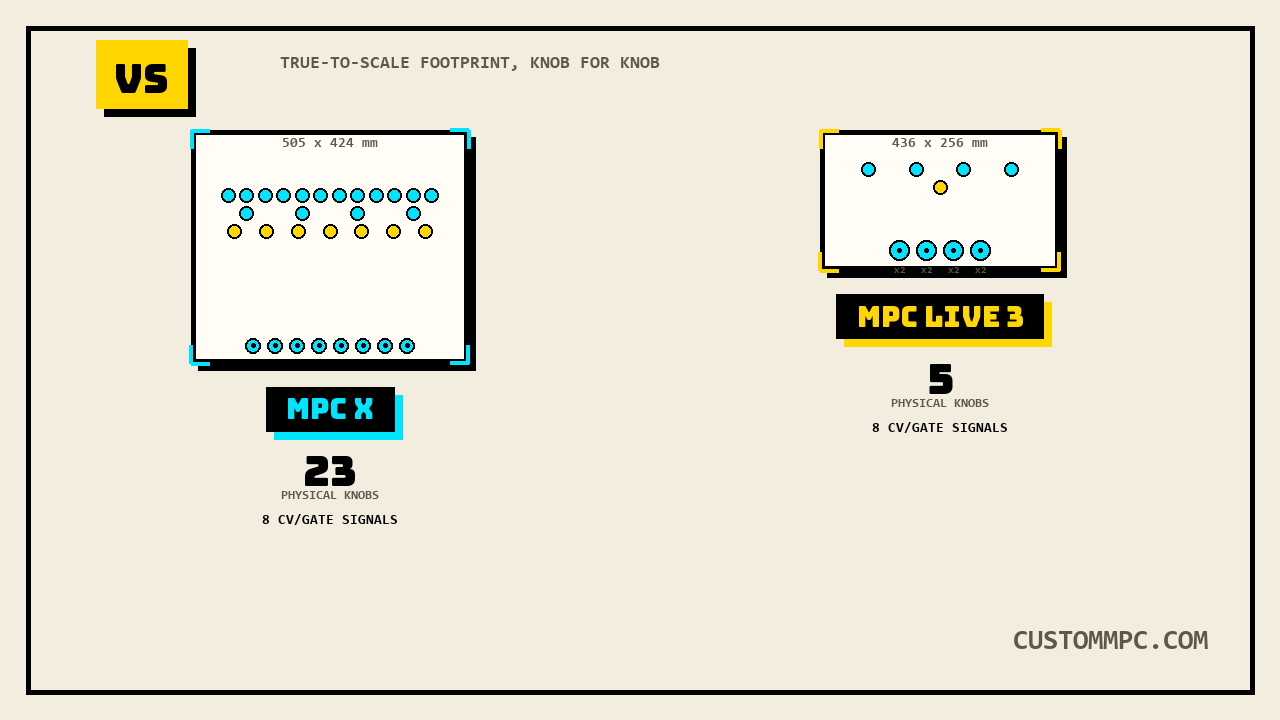
The short version
The MPC X and the MPC Live 3 have never been compared head to head on this site before, despite both sitting at the top of Akai's current standalone lineup by price: the X at a reported $1,999 launch price back in Q1 2017, the Live 3 at $1,699 when Akai announced it in October 2025. Read the Live 3's own dedicated user guide next to the shared v3.9 Standalone OS manual's own MPC X table and the split runs in two directions at once. The Live 3 wins the chip fight Akai actually documents, a named quad-core ARM processor against a Processor row the X's table has never had, quadruples its RAM (8 GB against 2 GB), and carries the only battery pack either machine has ever offered. The X answers back with 23 physical knobs against the Live 3's 5, twice the analog input jacks across twice the input categories, and two dedicated footswitch ports the Live 3's own current spec table drops entirely.
SAM'S NOTE: everyone treats the Live line as "the portable one" and the X as "the studio one," and the spec sheets back that up more literally than I expected. The Live 3 is the only current-lineup machine with a battery. The X is the only one of this pair with a dedicated instrument input and a footswitch jack. Neither table is trying to hide anything, they're just built for two different rooms.
Eight years, two very different jobs
The MPC X launched in the first quarter of 2017 at a reported $1,999 street price, Akai's rack-style, full-I/O standalone flagship, covered in full in this site's own mpc-x-buying-guide article and already compared against the original Live, the Key 61, and the One G2 in three earlier pieces on this site. The MPC Live 3 is a second-generation redesign of the original MPC Live line, announced October 2, 2025 at $1,699 (EUR 1,649.99, GBP 1,399.99), running its own separate "MPC 3" operating system on its own dedicated manual rather than the shared v3.9 Standalone OS User Guide the X, One, One G2, and Key 61/37 all share, a genuine documentation split this site's own mpc-live-2-vs-live-3 article already noted when it compared the Live 3 against its immediate predecessor. As of this writing the two sit eight years apart in launch date, with no direct successor to the X in Akai's current lineup, the same absence this site's mpc-key61-vs-mpc-x and mpc-one-g2-vs-mpc-x articles both already noted.
Spec sheet, straight from the manuals
Figures below are quoted or paraphrased directly from two separate current Akai documents: the MPC Live 3's own Technical Specifications section (MPC_Live_III_User_Guide_v3.6.pdf, printed footers 510-511) and the MPC X's Technical Specifications appendix inside the shared Standalone OS manual (MPC_Standalone_OS_User_Guide_v3.9.pdf, "MPC X / MPC X Special Edition" table, printed footers 468-470), both independently re-extracted for this article via direct page-indexed reads. Figures shown are for the base MPC X where the table splits by variant.
| Spec | MPC X | MPC Live 3 |
|---|---|---|
| Display | 10.1" / 256mm, 1280x800, capacitive multi-touch | 6.9" / 176mm diagonal, resolution not stated |
| Pads | 16 velocity- and pressure-sensitive RGB pads, 8 banks | 16 velocity-, pressure-, and 3D-sensing MPCe pads, 8 banks |
| Knobs | 16 Q-Link + 7 gain/mix + 1 data encoder = 23 | 4 Q-Link + 1 volume + 1 data encoder = 5 |
| Processor | Not named in this table | Quad-core ARM |
| RAM | 2 GB (X) / 4 GB (X SE) | 8 GB |
| Internal storage | 16 GB, 6 GB user (X); 48 GB, 10 GB user (X SE), expandable via SATA | 128 GB, expandable via SATA drive bay |
| Wi-Fi | Not documented | Present, no dedicated spec row |
| Bluetooth | Not documented | Present, no dedicated spec row |
| Mic/line inputs | 2x XLR+TRS combo (mic or line mode) plus 2x TRS-only (Input 3/4) = 4 jacks | 2x XLR+TRS combo (mic or line mode) = 2 jacks |
| Instrument inputs | 2x unbalanced 1/4" TS | None documented |
| Phono inputs | 2x unbalanced RCA | 2x unbalanced RCA |
| Footswitch / pedal inputs | 2x 1/4" TS footswitch (FS 1/2) | None in Connections block |
| Outputs | 8x 1/4" TRS (4 stereo pairs) | 6x 1/4" TRS (3 stereo pairs) |
| Headphone out | 1/4" TRS + 1/8" TRS | 1/4" TRS only |
| MIDI DIN | 2 in, 4 out | 2 in, 2 out |
| CV/Gate | 8x 1/8" TS jacks, 1 signal each, 8 signals total | 4x stereo 1/8" jacks, 2 signals each, 8 signals total |
| USB / SD | 2x Type-A, 1x Type-B, 1x SD card slot | 2x Type-A, 1x Type-C, 1x SD card slot |
| Power | External adapter, 19V 3.42A, no battery | External adapter, 19V 3.42A, plus li-ion battery, up to 3 hr |
| Dimensions (w x d x h) | 505 x 424 x 87mm (flat) | 436 x 256 x 67mm |
| Weight | 5.66 kg / 12.57 lb. | 4.3 kg / 9.46 lb. |
23 knobs against 5, the widest gap yet
The X's own Mechanical block lists three rows of physical rotary controls: 16 touch-sensitive Q-Link knobs, 7 additional 270-degree knobs dedicated to gain, mix, and level, and a data encoder, 23 knobs total by this site's established counting convention that excludes the encoder. The Live 3's own Mechanical block lists two: 4 touch-sensitive Q-Link knobs and a single 270-degree volume control, plus its own data encoder, 5 knobs total under that same convention. This site's mpc-key61-vs-mpc-x and mpc-one-g2-vs-mpc-x articles both already found the X's table landing against a 4-Q-Link machine, 23 to 4 in each case. The Live 3 breaks that exact pattern slightly, not because it has more Q-Link knobs, it has the same 4, but because its dedicated volume knob pushes its own total to 5 rather than 4. The direction of the gap is identical either way: the X still carries more than four times the physical rotary controls of any current-lineup machine this site has checked it against.
A processor the X's own table still won't name
The Live 3's own CPU block names its processor directly: "Processor: Quad-core ARM." The X's Technical Specifications table has no Processor or CPU row anywhere in it, and never has, per this site's own mpc-key61-vs-mpc-x and mpc-one-g2-vs-mpc-x articles, which already found and flagged the same gap. Worth disclosing rather than picking a side: this site's own mpc-live-2-vs-live-3 article already found a real conflict between Akai's own sources on this exact figure, the Live 3's manual says quad-core, its own product page and FAQ describe it as an 8-core chip and "4x the power" respectively. This article follows the manual's own Technical Specifications table, quad-core, as its primary citation, and flags the conflict rather than silently picking whichever number sounds better.
RAM and storage: no contest
The Live 3 documents 8 GB of RAM and 128 GB of internal storage. The base X documents 2 GB of RAM and 16 GB of storage (6 GB usable), with the pricier X Special Edition stepping up to 4 GB and 48 GB (10 GB usable). Read straight: the Live 3 quadruples the base X's RAM and doubles the Special Edition's, while its 128 GB of raw storage is more than double even the SE's 48 GB. Both machines keep the same structural expansion path despite the gap: the X's Memory block documents "Expandable via SATA connections," and the Live 3's Connections block goes a step further, naming a physical "(1) drive bay for 2.5" (635mm) SATA drive" outright. Neither table leaves storage expansion in doubt, the Live 3's is just more explicitly described.
Wireless that's real, but half-documented
Here the finding runs differently from this site's One G2 comparison. The One G2's own table names a full Wi-Fi and Bluetooth spec block, frequency bands, standards, and transmit power in dBm. The Live 3's Technical Specifications table has no equivalent block at all, no Wi-Fi or Bluetooth row of any kind sits in the printed spec pages. That doesn't mean the Live 3 lacks the hardware, its own manual documents both features functionally elsewhere: a dedicated Wi-Fi settings page for software updates and Ableton Link (printed page 59), and a dedicated Bluetooth settings page for pairing "Bluetooth MIDI controllers... or a Bluetooth computer keyboard" (printed page 2297 region). The X's table, by contrast, documents neither Wi-Fi nor Bluetooth anywhere, functionally or in spec form, the same gap this site's mpc-key61-vs-mpc-x and mpc-one-g2-vs-mpc-x articles already found. Worth flagging the same way this site's One G2 article flagged the One G2's own Bluetooth: the Live 3's manual describes Bluetooth strictly as a MIDI-controller and keyboard pairing feature, an HID-class use, with no mention anywhere of A2DP audio streaming. Whatever "Bluetooth" means on either machine, it isn't wireless audio output.
Four jacks against eight
The X's own Digital Audio System block documents four distinct categories of analog input: 2 balanced XLR+1/4" TRS combo jacks that switch between mic and line mode with a full preamp spec, 2 additional balanced 1/4" TRS-only jacks (Input 3/4, line level only, no XLR option), 2 unbalanced 1/4" TS instrument inputs, and 2 unbalanced RCA phono inputs, 8 physical input jacks across 4 categories in total. The Live 3's own block documents two: 2 balanced XLR+1/4" TRS combo jacks, described with the same mic-mode and line-mode split as the X's own Input 1/2, and 2 unbalanced RCA phono inputs, 4 physical input jacks across 2 categories, with no dedicated instrument input row anywhere in its table. Practically: both machines take a mic or line source through the same style of combo jack and both take a turntable through RCA phono, but the X adds a second, dedicated line-only stereo pair (Input 3/4) the Live 3's table has no equivalent of, and a pair of high-impedance instrument inputs for a guitar or bass plugged straight in that the Live 3's current documentation doesn't mention at all.
A jack the Live 3's table drops entirely
The X's own Connections block lists 2 dedicated 1/4" TS footswitch inputs (FS 1/2). The Live 3's own Connections block has no footswitch jack of any kind, confirmed by reading the block in full: combo XLR/TRS inputs, line outputs, headphone output, RCA inputs, MIDI in/out, CV/Gate, USB-A, USB-C, SD slot, power input, SATA bay, nothing else. The word "footswitch" does appear twice elsewhere in the Live 3's manual, but both are MIDI CC assignment features ("Footswitch 2 Destination," an "Enable or disables the use of a footswitch" toggle) meant for an external MIDI footswitch connected through a different port, not a dedicated physical 1/4" jack the way the X provides. This is a real, practical difference for anyone using a sustain-style footswitch for punch-in recording or live performance: the X takes one directly, the Live 3's current documentation offers no equivalent physical port.
CV/Gate ties again, the same way it didn't tie
Both tables land on 8 CV/Gate signals total, and this pair repeats a finding this site's own mpc-one-g2-vs-mpc-x article already established against a different machine: the total signal count matching does not mean the physical jack format matches. The X's own Connections block lists "(8) 1/8" (3.5 mm) CV/Gate outputs," 8 discrete jacks, 1 signal each. The Live 3's own Connections block lists "(4) Stereo 1/8" (3.5 mm) CV/Gate outputs," 4 physical jacks, each carrying 2 signals via a stereo breakout, the same 4-jack breakout format this site's mpc-one-g2-vs-mpc-x article already found on the One G2, now confirmed on a second machine. The practical cabling difference is identical to the One G2 case: sequencing a modular rig from the X means 8 individual patch cables into 8 individual jacks; doing the same from a Live 3 means 4 TRS-to-dual-mono breakout cables, even though both machines can drive the same 8 destinations.
The one thing only the Live 3 has
The Live 3's own Power block documents both an external adapter and a battery: "via power adapter: 19 V, 3.42 A, center-positive, included," and "via battery: lithium-ion, rechargeable, up to 3 hours of battery life with typical use." The X's own Power block documents the adapter only, "via power adapter: 19 V, 3.42 A, center-positive," identical voltage and amperage to the Live 3's own adapter, with no battery row at all. Worth a precise note rather than a blanket claim: the shared v3.9 Standalone OS manual's own Battery Usage section states plainly, "Only MPC Live and MPC Live II may use battery power. MPC X, One, One G2, Key 61, Key 37, and Key 37 G2 must be connected to a power outlet," a line this site's mpc-one-g2-vs-mpc-x article already cited. The Live 3 isn't named in that list at all, in either direction, because it runs its own separate MPC 3 manual outside that shared document rather than being a documentation oversight. Its own dedicated manual is the correct, and only, primary source for its battery spec, and it's unambiguous: up to 3 hours, the shortest of any battery-equipped MPC this site has documented so far (the original Live and Live II both cite longer figures in this site's own mpc-live-vs-live-ii article).
Weight, footprint, and one shared power brick
The X weighs 5.66 kg (12.57 lb.) against the Live 3's 4.3 kg (9.46 lb.), a real but modest gap next to this site's One G2 comparison's 2.7x difference. Footprint runs the same direction: the X's 505 x 424mm chassis covers roughly 214,000 square millimeters against the Live 3's 436 x 256mm rectangle at roughly 112,000, the X's footprint is close to double the Live 3's by area despite the weight gap being far smaller proportionally, reflecting the X's flatter, wider rack-style shape against the Live 3's more compact one. Unlike the One G2 comparison, where the two machines needed different adapters entirely, the X and Live 3 share the exact same external power spec, 19V, 3.42A, center-positive, meaning a spare X adapter genuinely could run a Live 3 in a pinch, and vice versa, a rare point of hardware overlap in an otherwise divergent pair.
What they actually cost right now
The MPC X launched at a reported $1,999 street price in Q1 2017; the MPC X Special Edition followed on April 26, 2023 at $2,499, per this site's own already-published mpc-x-buying-guide article. The MPC Live 3 launched October 2, 2025 at $1,699 (EUR 1,649.99, GBP 1,399.99), per this site's own already-published mpc-live-2-vs-live-3 article. At $1,699, the Live 3 costs 85 percent of the base X's own $1,999 launch price and roughly two-thirds of the Special Edition's $2,499, for a machine that quadruples the base X's RAM, more than doubles its documented storage, and adds a battery the X has never offered at any price, while losing badly on knob count and dedicated input variety. Both figures are launch-era press prices rather than current retailer listings, which shift with used-market pricing on the eight-years-discontinued X; confirm a specific listing's current asking price directly before buying either machine.
Common mistakes
Mistake: assuming the Live 3's stronger CPU, RAM, and storage numbers make it a straight upgrade over the X. Its own table has no instrument input, no footswitch jack, and a fifth of the X's knob count; "wins the spec sheet" and "does the same job" aren't the same claim here.
Mistake: expecting Bluetooth audio streaming from a Live 3. Its own manual documents Bluetooth strictly for MIDI controller and keyboard pairing, no A2DP or audio-streaming language anywhere.
Mistake: buying 8 single-signal patch cables for a Live 3's CV/Gate rig. Its own Connections block documents 4 stereo breakout jacks carrying 8 signals, not 8 discrete jacks the way the X uses; the cabling is different even though the total signal count matches.
Mistake: assuming the Live 3 has no battery because it isn't named in the shared Standalone OS manual's battery list. That list only covers the machines documented in that shared manual; the Live 3 runs its own separate manual, which documents a battery directly.
Mistake: assuming a Live 3's power adapter won't work on an X, or vice versa. Both document the identical 19V, 3.42A, center-positive spec, one of the only points of hardware overlap between these two machines.
A note on sources
This article draws from two separate current Akai documents rather than one shared manual: the MPC Live 3's own dedicated MPC_Live_III_User_Guide_v3.6.pdf (Technical Specifications, printed footers 510-511) and the MPC X's table inside the shared MPC_Standalone_OS_User_Guide_v3.9.pdf (printed footers 468-470). Both were independently re-extracted directly for this article rather than trusted forward from this site's own prior mpc-x-buying-guide or mpc-live-2-vs-live-3 articles, though every figure used here matched those two articles' own already-published citations exactly on cross-check. Several findings cross-reference this site's own previously published, independently sourced work rather than re-deriving the same primary-source citations from scratch: the X/Key 61 and X/One G2 knob-gap and CPU-gap findings (gear/mpc-key61-vs-mpc-x/, gear/mpc-one-g2-vs-mpc-x/), the CV/Gate breakout-format finding (gear/mpc-one-g2-vs-mpc-x/), the shared Battery Usage citation (gear/mpc-one-g2-vs-mpc-x/), the original Live/Live II battery figures (gear/mpc-live-vs-live-ii/), and the Live 3's own launch pricing and quad-core/8-core documentation conflict (gear/mpc-live-2-vs-live-3/). All were independently re-checked against the primary manual passages cited here during this pass rather than assumed correct, and matched.
Launch dates and pricing for both machines came from WebSearch-indexed press coverage rather than direct retailer fetches, consistent with this site's established practice on pricing claims; both figures are cross-referenced from this site's own mpc-x-buying-guide and mpc-live-2-vs-live-3 articles rather than re-derived from scratch.
Verdict
VERDICT
The specs: the Live 3's own table names a quad-core processor, quadruples the base X's RAM, more than doubles its documented storage, and adds a battery the X has never had at any price. The X answers back with 23 physical knobs against 5, twice the analog input jacks across twice the categories, a dedicated instrument input and footswitch jacks the Live 3's table has neither of, and a CV/Gate format that stays 8 discrete jacks rather than the Live 3's 4-jack breakout for the same total signal count. The purchase: the Live 3 is the grab-and-go pick for someone who wants to track vocals or a line source untethered from a wall outlet and doesn't need a guitar input or a footswitch; the X is still the knob-dense, full-I/O studio hub for anyone plugging in a mic, an instrument, a turntable, and a sustain pedal without an interface in between. The money: at $1,699 against the X's $1,999 launch price (or $2,499 for the Special Edition), the Live 3 costs 85 percent as much for a machine that wins the chip-and-memory argument outright, adds portable power the X has never offered, and loses the input-and-control-surface argument just as clearly. Match the machine to which argument actually matters for your rig before assuming the newer spec sheet, or the older one's I/O count, tells the whole story.
Own either one, or found a spec this checklist missed? Tell us what happened.