VS Comparison
MPC Live II vs MPC One: what's actually different
Both are current-lineup, both use the same 16 velocity- and pressure-sensitive pads, and buyers cross-shop them constantly, but this site has never put them side by side. Real specs from Akai's own Technical Specifications appendix on the button count that runs backward from price, the battery and phono jack the One skips entirely, and a genuine contradiction between two sections of Akai's own manual over whether the One even has an Ethernet port.
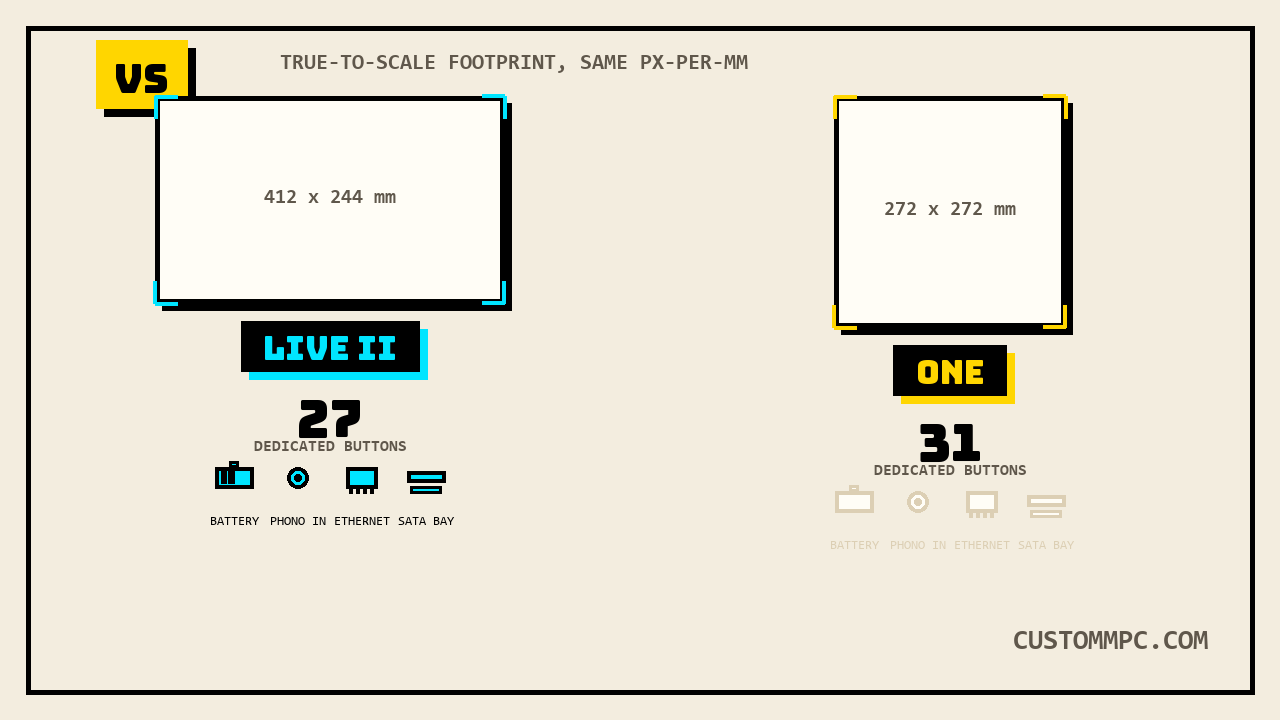
The short version
The MPC One is not a stripped-down Live II in a smaller shell. Akai's own Technical Specifications appendix lists the One with more dedicated hardware buttons than the Live II, a nearly identical touchscreen, and the same 16-pad surface, while the Live II carries the battery, the turntable-level phono input, four extra audio outputs, double the MIDI DIN ports, and a second USB-A port that the One's table doesn't list at all. Reading both units' full documentation together also turns up a real inconsistency inside Akai's own manual: whether the base MPC One has an Ethernet port at all depends on which section of the same PDF you read.
SAM'S NOTE: I get asked "Live II or One" more than almost any other buying question on this beat, usually from someone who assumes the pricier machine just does more of everything. It doesn't. Read the battery and phono sections before you decide which "more" you actually need.
Two years apart, same lineup
The MPC One was announced at NAMM in January 2020 and shipped the following month at a $699 MSRP, positioned as the compact, battery-free entry point into standalone MPC production. The MPC Live II followed in May 2020 at a $1,199 launch price, the battery-powered, phono-equipped sibling in the same first standalone-MPC generation as the MPC X. Unlike the Live 2/Live 3 pair this site already covered, where the older machine was discontinued, both the Live II and the One remain in Akai's current lineup as of this writing, each still documented in the current v3.9 Standalone OS User Guide alongside the newer One+, One G2, and Live III.
Spec sheet, straight from the manual
Every figure below is quoted or paraphrased directly from Akai's own MPC_Standalone_OS_User_Guide_v3.9.pdf Technical Specifications appendix: the "MPC Live II" table at PDF pages 472-474 (printed footers 472-474) and the "MPC One / MPC One+" table at PDF pages 474-476 (printed footers 474-476), a flat, zero-offset match between PDF page index and printed footer at this point in the appendix. Figures shown are for the base MPC One where the table splits by variant; the One+ storage and power-adapter differences are covered in their own section below.
| Spec | MPC Live II | MPC One |
|---|---|---|
| Display | 6.9" / 176mm, 150x93mm | 7.0" / 177mm, 151x94mm |
| Dedicated buttons | 27 | 31 |
| Pads / Q-Link | 16 velocity- and pressure-sensitive RGB pads, 8 banks; 4 touch-sensitive Q-Link knobs, 4 columns | |
| CPU / RAM | Quad-core ARM processor, 2 GB RAM | |
| Internal storage | 16 GB, expandable via SATA | 2 GB user + 2 GB pre-installed (One); 16 GB, 7.8 GB user (One+); no SATA listed |
| Battery | Lithium-ion, up to 4 hours | None; wall power required |
| Phono (RCA) input | Yes, dedicated spec block | No phono input block in this table |
| Line inputs | 2x 1/4" TRS (1 stereo pair) | |
| Outputs | 6x 1/4" TRS (3 stereo pairs) | 2x 1/4" TRS (1 stereo pair only) |
| Headphone out | 1/4" TRS | 1/8" TRS |
| MIDI DIN | 2 in, 2 out | 1 in, 1 out |
| CV/Gate outputs | 4, table says "Stereo" | 4, table omits "Stereo" |
| USB | 2x Type-A, 1x Type-B | 1x Type-A, 1x Type-B |
| Ethernet / Link | Yes, listed in this table | Not listed in this table (see below) |
| SD card slot | 1 | |
| Dimensions (w x d x h) | 411.5 x 243.8 x 45.7mm | 272 x 272 x 53mm |
| Weight | 3.38 kg / 7.45 lb. | 2.1 kg / 4.7 lb. |
The button count runs backward
Counted directly off each unit's own numbered front-panel walkthrough rather than the appendix's shorthand line, the Live II carries 29 numbered top-panel controls in its front-panel diagram (including the touchscreen, Data Dial, and Q-Link knobs as separate numbered items), while the appendix's Mechanical block rounds that down to "27 dedicated function buttons." The MPC One's own front-panel walkthrough runs to 31 numbered items, and its appendix Mechanical block states "31 dedicated function buttons" outright, four more than the Live II despite the One being the smaller, cheaper, battery-free unit. The reason traces to how each unit's workflow is laid out, not to the One simply having a busier panel: the Live II combines several modes onto single buttons accessed through Shift (Mix/Sampler toggles between Channel Mixer and Pad Mixer by default and reaches the Sampler via Shift; Mute/Sample Edit toggles Track Mute and Pad Mute by default and reaches Sample Edit via Shift), while the One's walkthrough gives several of those same functions their own separate buttons (Track Mix/Pad Mix as one button, Sampler/Looper as a second, separate button; Track Mute/Pad Mute as one button, Sample Edit/Q-Link Edit as a second, separate button). Net result: more physical buttons on the One does not mean more functions overall, since both units expose the same mode list, just split across a different number of physical presses.
Battery, phono, and the outputs the One drops
Three real, verified differences favor the Live II, and none of them show up in a casual spec-sheet skim of "both have 16 pads and a touchscreen." First, only the Live II carries a built-in battery. Akai's own "Battery Usage" section states this in the same sentence that covers the whole current lineup: "Only MPC Live and MPC Live II may use battery power. MPC X, One, One G2, Key 61, Key 37, and Key 37 G2 must be connected to a power outlet." Second, only the Live II's Digital Audio System block carries a dedicated Phono Inputs spec section, RCA-level gain figures included; the MPC One's table has no phono input section at all, only the same 1/4" TRS line inputs both units share. Third, the Live II's Connections list carries three times the physical output jacks: six 1/4" TRS outputs across three stereo pairs (Main plus two more) against the One's two 1/4" TRS outputs, one stereo pair only, meaning the One has no individual outs to route pads to separate mixer channels at all. The Live II also doubles the One's MIDI DIN capacity (2 in / 2 out against 1 in / 1 out) and carries a second USB Type-A port the One's table doesn't list, useful for running a flash drive and a MIDI controller at once instead of choosing between them.
The manual contradicts itself on Ethernet
Here is the finding worth flagging loudest. The Technical Specifications appendix's Connections list for "MPC One / MPC One+" does not mention an Ethernet or Link port at all, a real absence checked directly against the full ten-line Connections block quoted above. But the same manual's own rear-panel hardware walkthrough for the MPC One, a few dozen pages earlier, describes item 4 as: "Link: Connect a standard Ethernet cable to this port to use Ableton Link and other compatible devices with MPC One... Note: Not available on MPC One+." Read literally, that note only makes sense if the base MPC One does have a physical Ethernet Link port, since Akai bothers to specify that the One+ variant lacks it specifically, an odd caveat to write if neither model had the port. The Live II's own appendix table, by contrast, lists its Ethernet Link port plainly in its Connections block with no ambiguity. This site's sourcing standard is to state conflicts rather than silently pick a side, and this is a clean one: two sections of the identical PDF disagree on whether a current, still-sold product has a port on its own rear panel. If you specifically need wired networking on an MPC One, don't take the spec-table appendix's silence as the final word; check the physical unit or Akai's own rear-panel diagram instead.
A smaller, functionally harmless version of the same pattern shows up in the CV/Gate row. The Live II's appendix line reads "(4) Stereo CV/Gate outputs"; the One's reads "(4) CV/Gate outputs," missing the word "Stereo." Read on its own, that could suggest the One's jacks are simpler, single-signal jacks like the MPC X's. But both units' own rear-panel walkthroughs describe the jacks identically: "Use standard 1/8" (3.5 mm) TS cables to send a single CV/Gate signal per output, or use a stereo TRS-to-dual mono TSF breakout cable... to send two CV/Gate signals per output," word for word, on both the MPC Live II and MPC One panel descriptions. So the appendix's dropped "Stereo" on the One's row reads as an inconsistency in the table's own labeling, not a real functional difference; both machines top out at 4 jacks, 8 possible CV/Gate signals with breakout cables, same as this site's mpc-cv-gate-tracks article already established for the rest of the current lineup.
Storage: two variants, no SATA bay either way
The Live II's storage line is a single figure: "16 GB, expandable via SATA connections," with no breakdown of how much of that 16GB is actually free for a buyer's own samples, unlike the original MPC Live's table a few pages earlier in the same manual, which explicitly splits its identical 16GB into "6 GB user storage + 10 GB pre-installed content." Akai's own Live II table simply doesn't carry that split. The MPC One name covers two real storage configurations in the same table, and the gap between them is large enough to matter before you buy: the base MPC One ships with just 2GB of user storage plus 2GB of pre-installed content, while the MPC One+ carries 16GB of internal storage with 7.8GB actually free for user files. Neither One variant's table lists SATA expansion at all, the one storage option the Live II, the original Live, and the MPC X all document in their own Connections or Memory blocks; an MPC One owner who fills the internal storage is limited to the SD card slot both tables do list, with no internal-drive-swap path documented anywhere in this manual for either One variant. If you're shopping a used listing and the seller's title just says "MPC One," ask which variant it is before assuming which storage figure applies.
What they actually cost right now
The MPC One launched at a reported $699 MSRP in February 2020, positioned as Akai's entry-level standalone unit. The MPC Live II launched three months later at $1,199, a $500 premium that buys the battery, the phono input, the extra outputs and MIDI DIN ports, and the SATA expansion path documented above, none of which show up as line items on a spec sheet unless you read the full table the way this article does. Both figures are launch prices from press coverage rather than current retailer listings, which shift with periodic sale pricing and with the newer MPC One+ and MPC One G2 now sharing shelf space with the original One; confirm the specific unit's current asking price, and which variant it actually is, directly before buying.
Common mistakes
Mistake: assuming the pricier Live II simply has more buttons and controls. Akai's own Mechanical spec block credits the MPC One with 31 dedicated function buttons against the Live II's 27, the opposite of what the price gap suggests.
Mistake: buying an MPC One expecting a phono input or battery power. Neither exists in any documented configuration of the MPC One or One+; both are Live II (and original MPC Live) exclusives in the current lineup per Akai's own Battery Usage section and the missing Phono Inputs block.
Mistake: trusting the appendix's Connections list as the final word on the MPC One's Ethernet port. The appendix omits it; the same manual's own rear-panel walkthrough documents it, with an explicit note that it's absent specifically on the One+. Check the physical unit or the walkthrough diagram, not just the spec table.
Mistake: assuming "MPC One" always means the same storage figure. Base One ships with 2GB of user storage; One+ ships with 7.8GB. Confirm which variant a used listing actually is before you buy expecting either number.
A note on sources
Both spec tables cited in this article sit in the current v3.9 Standalone OS User Guide's Technical Specifications appendix: "MPC Live II" at PDF pages 472-474 (printed footers 472-474) and "MPC One / MPC One+" at PDF pages 474-476 (printed footers 474-476), with the two tables sharing a single page (474) where one ends and the other begins. Both front/rear-panel walkthroughs cited for the button-count and Ethernet findings sit earlier in the same manual, Live II at printed footer pages 354-357 and MPC One at printed footer pages 358-361, both ranges independently confirmed against their own printed page footers with no offset at this point in the document.
Launch dates and pricing for both machines came from WebSearch-indexed press coverage rather than direct retailer fetches, consistent with this site's established practice on pricing claims; the MPC Live II figures independently match what this site's own gear/mpc-live-2-vs-live-3 article already cites for the same machine, cross-checked here rather than re-derived from scratch. One press figure was checked and explicitly not used: general web coverage citing "2.7 kg" for the MPC Live II's weight matches Akai's own manual figure for the original MPC Live (5.9 lb. / 2.7 kg, PDF p.471), not the Live II (7.45 lb. / 3.38 kg, PDF p.474); this article uses the Live II's own primary-source figure and flags the press number here as a likely case of the two machine names getting conflated in secondary coverage, rather than silently repeating it.
Verdict
VERDICT
The specs: same pads, nearly identical touchscreen per Akai's own numbers (6.9" / 176mm on the Live II against 7.0" / 177mm on the One, a 1mm gap), but the MPC One's own spec block credits it with more dedicated buttons than the pricier Live II, 31 against 27, because the Live II folds more modes behind Shift combos. The purchase: the Live II is the one with the battery, the phono input, triple the output jacks, double the MIDI DIN ports, an extra USB-A port, and SATA expansion, none of which the One's table lists in any configuration; the One is smaller, lighter, cheaper, and, per Akai's own manual, may or may not have an Ethernet port depending which section you trust. The money: the One launched at $699 in February 2020, the Live II at $1,199 that May, a $500 gap that buys real hardware, not marketing. Buying used, confirm the One variant (base vs One+) before assuming either storage figure, and don't count on wired networking from the spec table alone.
Own both, or found a spec this checklist missed? Tell us what happened.