VS Comparison
MPC One G2 vs MPC X: what's actually different
Nine years and a $1,200 price gap apart, and on paper the newcomer wins the spec sheet: Akai's own manual names an 8-core processor for the One G2 where the X's table has never named one at all, doubles its RAM, and adds Wi-Fi and Bluetooth neither the X nor its Special Edition has ever had. Real specs from Akai's own Technical Specifications appendix on where that story flips hard the moment you count knobs, mic inputs, and outputs.
The short version
The MPC X and the MPC One G2 have never shared a shelf the way this site's other comparisons do: the X is a 2017 rack-style flagship, the One G2 a compact machine Akai announced on June 18, 2026, at $799, less than half the X's own $1,999 launch price. Read Akai's own Technical Specifications appendix side by side and the newcomer wins several rows outright: an explicitly named 8-core processor where the X's table has no Processor row at all, 4 GB of RAM against the X's 2 GB, 64 GB of internal storage against the X's 16 GB, and both Wi-Fi and Bluetooth radios the X has never documented. Then the story flips. The X's own Mechanical block still lists 23 physical knobs against the One G2's 4, real XLR mic preamps and phono inputs the One G2's table has none of, and roughly three and a half times the footprint by area to fit them all.
SAM'S NOTE: I keep seeing "the One G2 basically replaces the X" takes online and the spec table doesn't back that up either way. It beats the X on chip, memory, storage, and wireless, no argument. It also has no mic preamp, no phono input, and a quarter of the knobs. Replace implies one machine does the other's job. This one doesn't, it just does a different job for less money.
Nine years apart, one just weeks old
The MPC X launched in the first quarter of 2017 at a reported $1,999 street price, Akai's rack-style, full-I/O standalone flagship, covered in full in this site's own mpc-x-buying-guide article and compared against the original Live and the Key 61 in two earlier pieces on this site. The MPC One G2 is, by a wide margin, the newest machine this site has compared against anything: Akai announced it on June 18, 2026, alongside the MPC Key 37 G2, at $799 US (£729 UK, €849 EU), a from-scratch redesign of the original 2020 MPC One rather than a simple refresh, a distinction this site's own mpc-one-buying-guide article already drew out in detail. As of this writing the two sit nine years apart in launch date and roughly $1,200 apart in launch price, documented in the same current v3.9 Standalone OS User Guide alongside every other machine in Akai's current lineup, with no direct successor to the X and no G2 refresh of the Key 61, the same absence this site's own mpc-key61-vs-mpc-x article already noted.
Spec sheet, straight from the manual
Every figure below is quoted or paraphrased directly from Akai's own MPC_Standalone_OS_User_Guide_v3.9.pdf Technical Specifications appendix: the "MPC X / MPC X Special Edition" table at printed footers 468-470 and the "MPC One G2" table at printed footers 477-478, both independently re-extracted for this article via direct page-indexed reads of the isolated pages, and cross-checked against this site's own already-published mpc-x-buying-guide and mpc-one-buying-guide articles, which independently sourced the same two tables. Figures shown are for the base MPC X where the table splits by variant; the Special Edition's RAM and storage jump is covered in the RAM/storage section below.
| Spec | MPC X | MPC One G2 |
|---|---|---|
| Display | 10.1" / 256mm, 1280x800, capacitive multi-touch | 7.0" / 177mm diagonal, resolution not stated |
| Pads | 16 velocity- and pressure-sensitive RGB pads, 8 banks | |
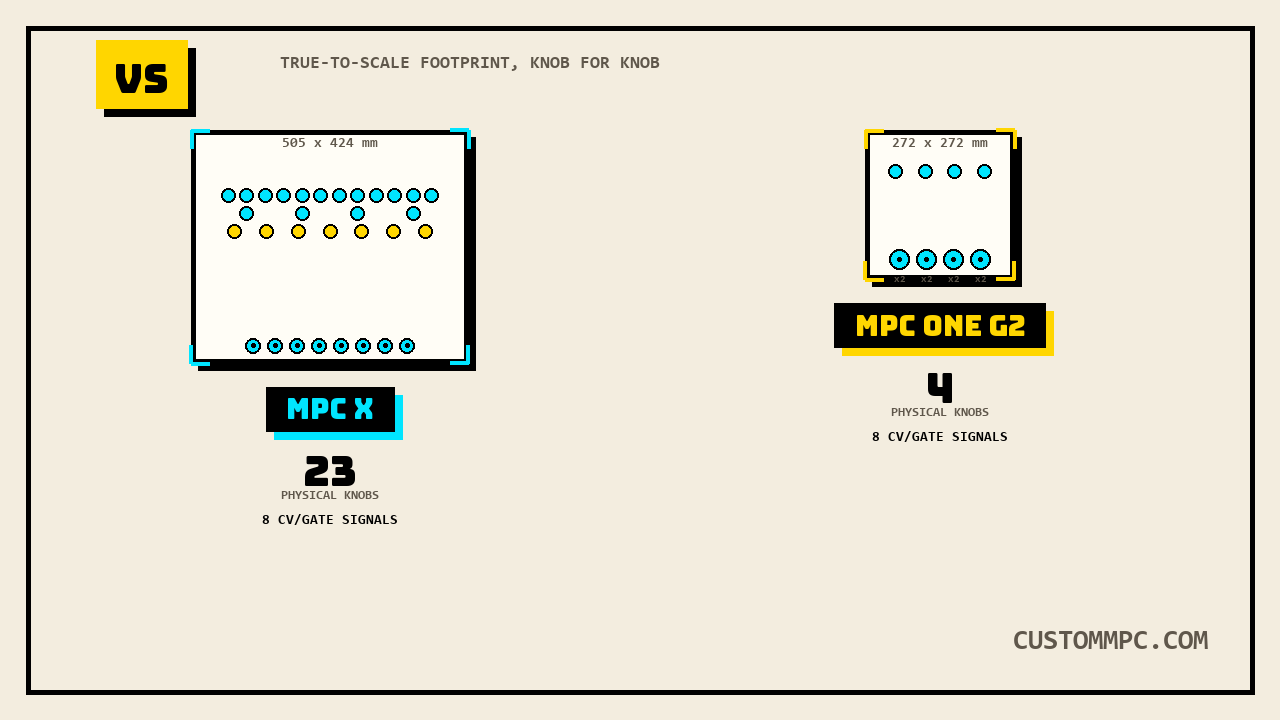
| Knobs | 16 Q-Link + 7 gain/mix + 1 data encoder = 23 | 4 Q-Link + 1 data encoder |
| Processor | Not named in this table | G2 eight-core processor |
| RAM | 2 GB (X) / 4 GB (X SE) | 4 GB |
| Internal storage | 16 GB, 6 GB user (X); 48 GB, 10 GB user (X SE), expandable via SATA | 64 GB internal, no SATA expansion listed |
| Wi-Fi | Not documented | 2.4/5 GHz, 802.11a/b/g/n/ac, +17 dBm |
| Bluetooth | Not documented | Version 5, HID profile, +10 dBm |
| Mic inputs | 2x XLR+1/4" TRS combo, preamp EIN -135 dBu | None documented |
| Line inputs | 2x balanced XLR+TRS (mic combo, doubles as line) plus 2x TRS (Input 3/4) | 2x balanced 1/4" TRS |
| Instrument inputs | 2x unbalanced 1/4" TS | None documented |
| Phono inputs | 2x unbalanced RCA | None documented |
| Footswitch / pedal inputs | 2x 1/4" TS footswitch (FS 1/2) | None documented |
| Outputs | 8x 1/4" TRS (4 stereo pairs) | 2x 1/4" TRS (1 stereo pair) |
| Headphone out | 1/4" TRS + 1/8" TRS | 1/8" TRS only |
| MIDI DIN | 2 in, 4 out | 1 in, 1 out |
| CV/Gate | 8x 1/8" TS jacks, 1 signal each, 8 signals total | 4x TRS jacks, 2 signals each, 8 signals total |
| USB / SD | 2x Type-A, 1x Type-B, 1x SD card slot | 1x Type-A, 1x Type-C, 1x SD card slot |
| Power | External adapter, 19V 3.42A, no battery | External adapter, 12V 3A, no battery |
| Dimensions (w x d x h) | 505 x 424 x 87mm (flat) | 272 x 272 x 53mm |
| Weight | 5.66 kg / 12.57 lb. | 2.1 kg / 4.7 lb. |
The knob gap runs backwards, again
Akai's own Mechanical block for the MPC X lists three rows of physical rotary controls: 16 touch-sensitive Q-Link knobs, 7 additional 270-degree knobs dedicated to gain, mix, and level, and a data encoder, 23 knobs total by this site's established counting convention that excludes the encoder. The One G2's own Mechanical block lists exactly one knob row: 4 touch-sensitive Q-Link knobs across 4 Q-Link columns, plus the same style of data encoder. This is the second time this exact 23-to-4 split has shown up on this site: the mpc-key61-vs-mpc-x article already found the identical gap against the Key 61. Two different Akai machines, a keyboard workstation and now a compact standalone, both land on 4 Q-Link knobs against the X's 23, suggesting 4 is Akai's settled knob count for its newer, smaller-format hardware rather than a one-off design choice specific to either machine.
A processor line the X's table has never had
The One G2's own CPU block names its processor directly: "G2 eight-core processor." The X's Technical Specifications table has no Processor or CPU row anywhere in it, and never has, a documentation gap this site's own mpc-key61-vs-mpc-x article already found when it checked the same table against the Key 61. Naming a chip doesn't automatically make it faster in absolute terms, Akai's own spec table gives no clock speed or benchmark for either machine, but it is a real, documented asymmetry: the $799 machine tells you what's inside it, the $1,999 machine's own current manual doesn't say at all.
RAM and storage: the cheap one wins on paper
The One G2 documents 4 GB of RAM and 64 GB of internal storage. The base MPC X documents 2 GB of RAM and 16 GB of internal storage (6 GB of that usable), with the pricier MPC X Special Edition stepping up to 4 GB of RAM and 48 GB of storage (10 GB usable). Read straight: the $799 One G2 ties the $2,499 X Special Edition on RAM exactly, and beats the $1,999 base X by double, while its 64 GB of raw internal storage outnumbers even the SE's 48 GB. The X keeps one real structural advantage the raw numbers don't show: its own Memory block documents storage expansion "via SATA connections," a path to adding a full internal drive. The One G2's table lists no SATA row at all, an SD card slot in its Connections block is the only expansion path its documentation names.
Wireless: a first for either machine
The One G2's own table documents both a Wi-Fi radio (2.4 GHz and 5 GHz, 802.11a/b/g/n/ac, up to +17 dBm) and Bluetooth (version 5, HID profile, up to +10 dBm). The X's table has no Wi-Fi or Bluetooth row anywhere, the same gap this site's mpc-key61-vs-mpc-x article already found and flagged as shared with the Key 61, now confirmed a third time against the One G2 too. Worth flagging plainly: the Bluetooth profile listed is HID, Human Interface Device, the class used for keyboards, mice, and remote-control style input, not A2DP audio streaming. Nothing in the One G2's own table suggests it can receive or send Bluetooth audio; what its documentation supports is Bluetooth as a control-surface link, not a wireless output.
No XLR, no phono, no instrument input
Here the story reverses hard. The X's own Digital Audio System block documents 2 balanced XLR+1/4" TRS combo mic inputs with a full preamp specification, gain range, EIN noise floor, dynamic range, all listed, plus 2 unbalanced 1/4" TS instrument inputs and 2 unbalanced RCA phono inputs with their own dynamic range and THD+N figures. The One G2's table has none of these three input types: its Line Inputs block lists only 2 balanced 1/4" TRS jacks, no XLR combo option, no dedicated instrument input, no phono row anywhere. Practically: the One G2 can take a line-level signal from a synth, mixer, or DI'd instrument, but Akai's own current documentation gives it no XLR mic preamp for direct vocal or acoustic recording, no dedicated high-impedance instrument input for a guitar or bass plugged straight in, and no phono stage for sampling a turntable without an external interface in between. The X's own table supports all three natively.
CV/Gate ties in count, breaks in format
Both tables land on 8 CV/Gate signals, but they get there differently, and this is worth stating precisely because this site's own mpc-key61-vs-mpc-x article already established a genuine parity finding between the X and the Key 61, 8 discrete 1/8" TS jacks on each, one signal per jack. The One G2 does not repeat that format: its own Connections block lists "(4) TRS CV/Gate jacks (8 Outputs total)," meaning each of its 4 physical jacks breaks out two signals via a TRS cable, not 8 separate physical jacks the way the X and Key 61 both use. The practical difference: sequencing a modular rig or an analog drum machine from the X or the Key 61 means 8 individual patch cables into 8 individual jacks. Doing the same from a One G2 means 4 TRS-to-dual-mono breakout cables, a real difference in cabling and one this site's own gear/mpc-cv-gate-tracks article, which surveyed the X's jack format specifically, didn't have occasion to check against the One G2.
Screen size and a resolution gap that repeats
The X's table states its screen resolution explicitly: "10.1" (25.6 cm) full-color 1280x800 display with capacitive multi-touch." The One G2's table states only a diagonal size and panel type: "7.0" / 177 mm (diagonal)," "Full-color LED-backlit display with touch interface," no pixel resolution given anywhere. This is the same documentation gap this site's own mpc-key61-vs-mpc-x article already found on the Key 61's own display row, now confirmed a second time on a different current-lineup machine. This site's own mpc-live-ii-vs-one and mpc-live-vs-live-ii articles both confirmed 1280x800 as the shared resolution across the Live II, One, and original One G2's sibling tables in that part of the appendix; whether the One G2 shares that same figure or runs something different isn't stated in its own current documentation, and this article doesn't assume it forward from a sibling machine's spec.
Weight, footprint, and a nearly 3x gap
The X weighs 5.66 kg (12.57 lb.) against the One G2's 2.1 kg (4.7 lb.), a 2.7x difference, and the footprint gap runs in the same direction: the X's 505 x 424mm chassis covers roughly 214,000 square millimeters against the One G2's 272 x 272mm square at roughly 74,000, about a third the area. Both run on external power adapters with no battery option, per the same "must be connected to a power outlet" line in the manual's Battery Usage section that already ruled out battery power for the X, One, One G2, Key 61, Key 37, and Key 37 G2 alike; only the Live and Live II carry a battery. The power adapters themselves don't interchange either: the X ships with a 19V, 3.42A brick, the One G2 with a 12V, 3A brick, a real voltage mismatch worth checking before assuming a spare adapter works across either machine, let alone across this pair.
What they actually cost right now
The MPC X launched at a reported $1,999 street price in Q1 2017; the MPC X Special Edition followed on April 26, 2023 at $2,499, per this site's own already-published mpc-x-buying-guide article. The MPC One G2 launched June 18, 2026 at $799 US (£729 UK, €849 EU per the announcement's own listed regional pricing), per this site's own already-published mpc-one-buying-guide article. At $799, the One G2 costs 40 percent of the base X's own $1,999 launch price and roughly a third of the Special Edition's $2,499, for a machine that beats both on RAM, storage, and named processor, loses badly on knob count and analog input variety, and is 2.7x lighter to carry. All figures here are launch-era press prices rather than current retailer listings, which shift with used-market pricing on the nine-years-discontinued X; confirm a specific listing's current asking price directly before buying either machine.
Common mistakes
Mistake: assuming the One G2's stronger CPU, RAM, and storage numbers make it a straight upgrade over the X. Its own table has no mic preamp, no instrument input, no phono input, and a quarter of the X's knob count; "better on paper" and "does the same job" aren't the same claim here.
Mistake: expecting Bluetooth audio streaming from a One G2. Its own table names the HID profile only, the device-control class used for keyboards and remotes, not A2DP audio.
Mistake: buying 8 single-signal patch cables for a One G2's CV/Gate rig. Its own Connections block documents 4 TRS breakout jacks carrying 8 signals, not 8 discrete jacks the way the X and Key 61 both use; the cabling is different even though the total signal count matches.
Mistake: assuming the One G2's power adapter is a drop-in swap for an X's. The X's brick is rated 19V 3.42A, the One G2's 12V 3A, a real mismatch, not a rounding difference.
Mistake: assuming the One G2's 7.0" screen shares the One/Live II family's 1280x800 resolution. Akai's own current table for the One G2 states a diagonal size only, no resolution figure; that's a real documentation gap, not a confirmed match to a sibling machine.
A note on sources
Both spec tables cited in this article sit in the current v3.9 Standalone OS User Guide's Technical Specifications appendix, "MPC X / MPC X Special Edition" at printed footers 468-470 and "MPC One G2" at printed footers 477-478, each independently re-extracted directly for this article rather than trusted forward from this site's own prior mpc-x-buying-guide or mpc-one-buying-guide articles, though every figure matched those two articles' own already-published tables exactly on cross-check. Several findings in this article cross-reference this site's own previously published, independently sourced work rather than re-deriving the same primary-source citations from scratch: the X/Key 61 CV/Gate parity finding this pair does not repeat (gear/mpc-key61-vs-mpc-x/), the CV/Gate jack context for the X specifically (gear/mpc-cv-gate-tracks/), the 1280x800 resolution figure for sibling machines (gear/mpc-live-ii-vs-one/ and gear/mpc-live-vs-live-ii/), and both machines' own launch pricing (gear/mpc-x-buying-guide/ and gear/mpc-one-buying-guide/). All were independently re-checked against the primary manual passages cited here during this pass rather than assumed correct, and matched.
Launch dates and pricing for both machines came from WebSearch-indexed press coverage rather than direct retailer fetches, consistent with this site's established practice on pricing claims; both figures are cross-referenced from this site's own mpc-x-buying-guide and mpc-one-buying-guide articles rather than re-derived from scratch.
Verdict
VERDICT
The specs: the One G2's own table names an 8-core processor, 4 GB RAM, 64 GB storage, and both Wi-Fi and Bluetooth, all things the X's current table either loses on or never documents at all. The X answers back with 23 physical knobs against 4, real XLR mic preamps, instrument inputs, and phono inputs the One G2's table has none of, 8 audio outputs against 2, and a CV/Gate format that stays 8 discrete jacks rather than the One G2's 4-jack breakout for the same total signal count. The purchase: the One G2 is the compact, chip-and-connectivity-forward pick for someone tracking line-level and MIDI gear who wants Wi-Fi file transfer and doesn't need a mic preamp built in; the X is still the knob-dense studio hub for anyone who wants to plug in a mic, an instrument, and a turntable directly with no interface in between. The money: at $799 against the X's $1,999 launch price (or $2,499 for the Special Edition), the One G2 costs a third to two-fifths as much for a machine that wins the chip-and-memory argument outright and loses the input-and-control-surface argument just as clearly. Match the machine to which argument actually matters for your rig before assuming the newer or cheaper spec sheet tells the whole story.
Own either one, or found a spec this checklist missed? Tell us what happened.