VS Comparison
MPC4000 vs MPC5000: what actually changed
Both were Akai's own flagship standalone MPC at launch, six years apart: the 4000 in 2002, the 5000 in December 2008. This site has covered each in its own buying guide but never put them side by side. Read straight from Akai's own manuals, the newer machine loses on almost every sequencer and sample-engine row, gains a filter section and an onboard arpeggiator the 4000 never had, and drops SCSI entirely for a CompactFlash slot.
The short version
The MPC4000 and MPC5000 have never been compared directly on this site, despite both holding the same title six years apart: Akai's own standalone flagship at the moment each one shipped. Read side by side from Akai's own Service Manual and Reference Manual, the story isn't a clean generational upgrade. On sequencer capacity, sampling engine, and pro I/O, the 2002 MPC4000's own spec table beats the 2008 MPC5000's on almost every line: triple the maximum sequencer events, double the tracks per sequence, 96kHz/24-bit sampling against 44.1kHz/16-bit only, XLR combo jacks and a documented phono preamp with RIAA EQ, a Word Clock input, dedicated SMPTE ports, and a USB host port the 5000's table doesn't carry. The 5000 answers back with real advances Akai clearly spent the newer machine's budget on instead: a genuinely more sophisticated multi-mode filter section, a documented onboard multi-effects architecture and the first arpeggiator in an MPC, S/PDIF and ADAT optical shipped standard rather than bolted on with an optional board, and a CompactFlash-based storage system in place of SCSI entirely.
DEX'S NOTE: I've had people tell me the 5000 is "basically a 4000 with a better filter," like it's a straight upgrade. It isn't, not on paper. The 4000's own spec table beats it on sequencer size, sample rate, and half the I/O list. What the 5000 actually bought you for a higher launch price was a better sound-shaping engine and a lot less time spent shopping for optional boards. Different trade, not a strict upgrade.
Six years, flagship to flagship
The MPC4000 launched in September 2002 at £2,299 including VAT, positioned above the already-best-selling MPC2000XL as Akai's genuine studio flagship, covered in full in this site's own mpc4000-buying-guide article. Sound on Sound's launch review called it "undoubtedly the most evolved" MPC of its era with a sequencer "much more powerful than its forebears," while flagging early-unit OS stability as "not fully up to scratch" and noting plainly that "digital connections really should be standard," a line that turns out to matter directly for the I/O comparison below. The MPC5000 followed six years later, released December 2008 at $3,499 in the US (£1,699 including VAT in the UK), covered in full in this site's own mpc5000-buying-guide article. Sound on Sound's review called it a "beefed-up big brother to the MPC2500" and praised the doubled 64-voice polyphony and the multitimbral synth engine's arpeggiators, but had real reservations too: 8-track hard-disk recording felt "a bit diddy" with no auto-locate or punch-in, the stereo beat-slicing algorithm was "annoyingly haphazard," and effect routing was "limited to a single send per track," a constraint that reads differently once the 4000's own four-bus send architecture is on the table, covered further down. Both machines predate the current MPC3-OS standalone lineup by a decade or more and ran their own dedicated OS families; neither appears in the current v3.9 Standalone OS User Guide this site's modern-lineup coverage draws from.
Spec sheet, straight from the manual
Every figure below is quoted or paraphrased directly from Akai's own documents: the MPC4000 Service Manual's "I. SPECIFICATIONS" section (_mpc4000_service_djvu.txt, printed/PDF page 3) and the MPC5000 Reference Manual v2.00's own "Specifications" section (_mpc5000_reference_v2.txt, printed page 200-201), both re-read directly for this article rather than only carried forward from either sister buying guide's own table.
| Spec | MPC4000 | MPC5000 |
|---|---|---|
| Launched | September 2002, £2,299 (UK) | December 2008, $3,499 (US) |
| Display | 320x240 dot grey-scale LCD w/backlight | 240x128 dot graphic LCD w/backlight |
| Storage | 50-pin SCSI connector (standard) | CompactFlash, 32MB-2GB card |
| Dimensions (as printed) | 526(W) x 170(H) x 453(D) mm | 18in x 16-1/16in x 3-3/8in, no axis labels given |
| Weight | 10.5 kg (~23.1 lb.) | 18.2 lb. (~8.3 kg) |
| Power | 100-240V AC, 50/60Hz, 70W (27W without options) | 50W, no voltage range stated |
| Sampling rate | 44.1 / 48 / 96kHz | 44.1kHz only |
| Data format | 24/16-bit linear | 16-bit linear only |
| Memory, standard | 16MB | 64MB |
| Memory, expandable to | 512MB (2x 168-pin DIMM) | 192MB (1x EXM-E3 card) |
| Polyphony | 64 voices | |
| Filter | 2-pole x3 with resonance, no named types | State Variable, up to 8-pole, 7 named types |
| Onboard effects (spec table) | No dedicated Effects block in this table | 4 stereo busses, 2 effects/buss, Master EQ+Comp |
| Arpeggiator | Not documented | Yes, Akai's first onboard arpeggiator |
| Sequencer, max events | 300,000 notes | 100,000 notes |
| Sequencer resolution | 960 parts per 1/4-note | |
| Sequences | 128 | 99 |
| Tracks per sequence | 128 | 64 |
| MIDI output channels | 64 (16 channels x 4 ports) | |
| Song mode | 128 songs, 250 steps | 20 songs, 250 steps |
| Drum pads | 16, velocity and pressure sensitive | |
| Drum pad banks | 6 | 4 |
| Sync modes | MTC, MIDI clock, SMPTE | MIDI clock, MIDI Time Code |
| Rec inputs | XLR/TRS combo L/R + separate RCA phono w/RIAA EQ | MIC/TRS combo L/R + RCA phono preamp, one line item |
| Main outs | XLR/TRS combo, balanced | 1/4" TRS, balanced, no XLR |
| 8 assignable outs | Optional, IB-48P board required | Standard, no board required |
| Digital I/O (S/PDIF) | Optional, IB-4D board required | Standard |
| ADAT | Optional, IB-4ADT board (2-in/8-out) | Standard, ADAT Optical x1 (8ch) |
| Word Clock | BNC in, optional, IB-4D required | Not documented |
| SMPTE ports | Dedicated 1/4" in + out jacks | Not documented as dedicated jacks |
| Headphone | 60mW / 32ohm | 200mW / 100ohm |
| Footswitch | 2x 1/4" | |
| MIDI DIN | 2 in, 4 out | 2 in, 4 out |
| USB | Host x1, Slave x1 (v1.1) | Slave only, Mass Storage Class |
| Options | IB-4D, IB-4ADT, IB-48P (I/O boards) | EXM-E3 (memory), CDM-25 (CD/DVD) |
The sequencer shrinks on every row
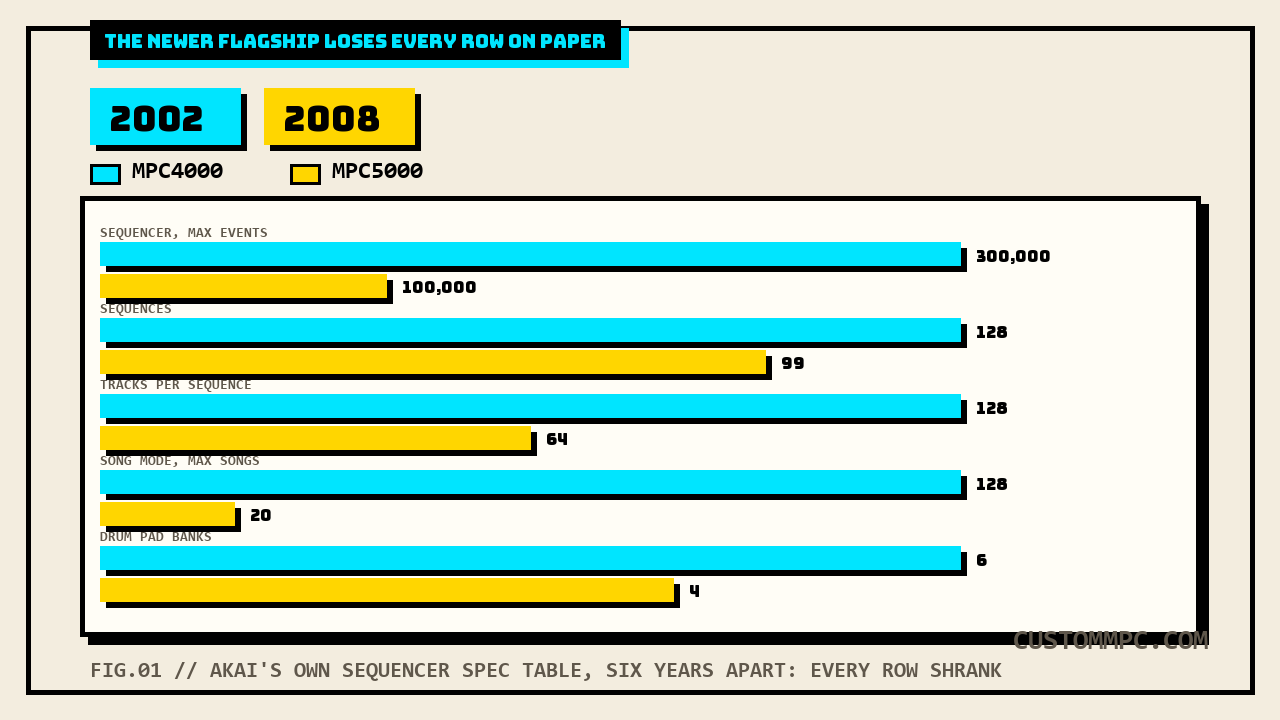
Akai's own Sequencer block for the MPC4000 documents 300,000 maximum notes, 128 sequences, 128 tracks per sequence, and 128 songs at 250 steps each. The MPC5000's own Sequencer block, read directly for this article rather than trusted forward from either sister buying guide, documents 100,000 maximum notes, 99 sequences, 64 tracks per sequence, and 20 songs at 250 steps each. Every one of those four figures is smaller on the newer machine, by a factor ranging from 1.3x (128 to 99 sequences) up to 6.4x (128 to 20 songs). Drum pad banks follow the same direction: 6 on the 4000 against 4 on the 5000, a difference of 32 total pads (96 against 64) across the whole banked set even though both machines share the identical 16-pad, velocity-and-pressure-sensitive physical surface. The two specs that don't move are sequencer resolution, 960 ppq on both, and MIDI output channel count, 64 channels across 4 ports on both, so the regression is specifically about how much a session can hold, not how finely either machine can time a note or how many external channels it can address.
96kHz/24-bit against 44.1kHz/16-bit
The MPC4000's own Sound Generator block documents three selectable sampling rates, 44.1kHz, 48kHz, and 96kHz, at a choice of 24-bit or 16-bit linear data format, with a full table of recording-time figures for every rate/bit-depth combination. The MPC5000's own Sound Generator block documents one sampling rate, 44.1kHz, at one data format, 16-bit linear, full stop. Neither manual states a reason for the drop; it's disclosed here as a real, documented regression rather than assumed to be a simplification for cost or workflow reasons the manuals themselves don't give. Memory tells a split story. The 5000 ships with four times the standard sample memory out of the box, 64MB against the 4000's 16MB, so a stock unbuilt-up 5000 actually holds more sample time on day one. But the expansion ceiling runs the opposite direction and by a wider margin: the 4000 tops out at 512MB across two 168-pin DIMM slots, the 5000 at 192MB through a single EXM-E3 card, a 2.67x gap in the other machine's favor. A buyer planning to max out either machine's memory ends up with more headroom on the older one; a buyer planning to run either one bone stock gets more sample time from the newer one.
Where the 5000 actually wins
The filter section is the clearest real generational advance in either direction. The 4000's own Sound Generator block names a flat "2-pole x3 with resonance" filter, no named filter types, no per-voice mode selection documented anywhere in the spec table. The 5000's own block names a State Variable Filter running up to 8-pole depending on type, with seven distinct named filter types: Low Pass, Band Pass, High Pass, Band Boost, Band Stop, Analog Modeling, and Vocal Formant. That's a real jump in sound-design range, not a documentation-format difference like several of the gaps elsewhere in this comparison. The arpeggiator is a flat win too: this site's own mpc5000-buying-guide article already established the 5000 as Akai's first MPC with an onboard arpeggiator, sourced directly from Akai's own reference manual. A direct string search of both MPC4000 manuals on file for this article turns up zero matches for "arpeggiat" anywhere, confirming the feature simply doesn't exist on the earlier machine rather than being under-documented. Effects are the one finding in this section that needs a caveat instead of a flat verdict. The 5000's own spec table names a fixed architecture, 4 stereo busses with 2 stereo effects per buss plus a Master effect (4-band EQ and Compressor). The 4000's Service Manual spec table has no Effects block at all, but its Owner's Manual body documents a real, separate 4-effect architecture (Effects 1-4, each fed by one of four send busses A-D, adjacent pairs stereo-linkable on demand), a genuine documentation-table gap rather than a hardware absence. And Sound on Sound's own 2008 review of the 5000 called its own effect routing "limited to a single send per track," a real-world constraint that reads differently once the 4000's four-send-bus system is on the table: it isn't obviously the more limited machine here, the two manuals just describe their effects sections in incompatible levels of detail, disclosed as a genuine gap rather than resolved either way.
Optional boards against stock I/O
This site's own mpc3000-vs-mpc4000 article already flagged that a bare 4000 can ship with less standard I/O than a bare MPC3000, since the 4000's 8 assignable outputs need the optional IB-48P board and its digital audio needs the optional IB-4D board. That same gap shows up again here, on the opposite side: every one of those features that was optional on the 4000 is standard, no board required, on the 5000. The 5000's own I/O block lists 8 individual outputs, S/PDIF digital in and out, and ADAT Optical (8 channels) with no "(optional)" qualifier anywhere on any of those three lines. Sound on Sound's own 2002 review of the 4000 flagged exactly this as a weak point at launch, writing plainly that "digital connections really should be standard." Akai's answer arrived six years later, on the 5000, not on any later revision of the 4000 itself. The trade runs the other direction on pro-audio inputs, though: the 4000's own Rec In block documents a dedicated RCA Phono input with a full RIAA EQ spec, and a separate Main Out block with XLR/TRS combo jacks on both the mic-line inputs and the main outputs. The 5000's own Record input line folds a phono preamp into the same combo-jack spec without a dedicated RIAA EQ line, and its Stereo output block lists plain 1/4" TRS jacks only, no XLR anywhere in the table.
SCSI is gone, not just optional
Every vintage MPC this site has covered so far, MPC60, MPC2000, MPC2000XL, and MPC3000, either shipped with SCSI standard or could add it as a period upgrade board, which is why the SCSI2SD and ZuluSCSI storage mods keep coming up across this site's own coverage. The 4000 continues that lineage: a 50-pin high-pitch SCSI connector, standard equipment, no board required, per its own Rear Panel block. The 5000 breaks it entirely. Its own General block names a CompactFlash Memory Card Slot, sized 32MB to 2GB, as the machine's storage interface, and the full Specifications section has no SCSI line anywhere. That's a real architecture change, not a smaller or optional version of the same feature: there's no SCSI bus on a 5000 to run a SCSI2SD adapter into in the first place. Practically, that means a used-5000 buyer doesn't need to budget for a SCSI storage mod at all, the way a used-4000, 3000, or 2000XL buyer typically does; a period-correct CompactFlash card, or a modern high-capacity one within that 2GB ceiling, is native storage on day one. It also means a bare 5000 with a missing or dead floppy-era storage habit isn't a repair problem the way a dead SCSI drive on the older machines is, since there's no SCSI drive to fail in the first place.
A USB host port that disappears
The 4000's own Rear Panel block lists two separate USB roles: a Host port and a Slave port, both version 1.1. The 5000's own Inputs/Outputs block lists one: a Slave connector supporting USB Mass Storage Class, with no Host port anywhere in the table. A host port lets the machine itself act as the controller for a connected USB device; without one, the 5000 can only be connected to a computer as a storage device, not the other way around. Given the 5000 replaced SCSI with CompactFlash rather than leaning further into USB peripherals, the missing host port reads as consistent with that same storage-architecture shift rather than an isolated omission: neither SCSI nor USB-host peripheral support carried forward from the 4000 to the 5000, and CompactFlash is the one storage path both machines' own manuals agree the 5000 actually supports.
The higher-res screen is on the older machine
The 4000's own General block states its display resolution explicitly: 320x240 dots, grey-scale, graphical LCD with backlight, 76,800 total dots. The 5000's own General block states 240x128 dots, graphic LCD with backlight, 30,720 total dots, well under half the pixel count of the six-years-older machine. Both figures come straight from each machine's own manual, not converted or estimated, and the gap runs backwards from what a buyer shopping by launch year would expect. Weight and footprint split the other direction: the 5000 is the lighter machine at 18.2 lb. (roughly 8.3kg by this article's own conversion) against the 4000's 10.5kg (roughly 23.1 lb.), and its own Dimensions block gives 18in x 16-1/16in x 3-3/8in (6-7/8in with the screen raised) against no stated axis labels, unlike the 4000's own explicitly labeled 526(W) x 170(H) x 453(D) mm. Whether the 5000's three figures print in width/depth/height order or some other order isn't stated anywhere in its own manual; disclosed here as a real documentation gap rather than assumed to match the 4000's own W/H/D convention.
What they actually cost right now
The 4000 launched at £2,299 including VAT in September 2002; this site's own mpc4000-buying-guide article found used listings running from roughly $500 for a bare working unit up past $2,100 for an excellent-condition example with extras. The 5000 launched at $3,499 in the US that December six years later; this site's own mpc5000-buying-guide article found a similarly wide spread, from roughly $182 at the low end of an aggregator's listing data up to $1,500 for a complete, currently-active listing. Both ranges are scattered samples rather than clean averages, the same caveat both sister buying guides carry individually, and neither converts cleanly against the other since the 4000's launch price is a UK figure including VAT and the 5000's is a US figure that typically wouldn't include local tax. What's clear either way: the 5000 launched at the higher headline price of the two, and bought a better filter section, an arpeggiator, and stock digital/assignable I/O for that premium, while giving up sequencer capacity, sample rate options, and SCSI in the trade.
Common mistakes
Mistake: assuming the newer 5000 is a strict upgrade over the 4000. Its own Sequencer block documents smaller figures on every row, max events, sequences, tracks, and songs, and its Sound Generator block drops to a single sampling rate and bit depth where the 4000 offered three rates and two depths.
Mistake: planning a SCSI2SD or ZuluSCSI storage mod for an MPC5000. Its own General block documents a CompactFlash card slot as the storage interface; the full Specifications section has no SCSI line at all, unlike the 4000, 3000, 2000XL, or 60.
Mistake: expecting a bare MPC4000 to have digital I/O or 8 assignable outputs out of the box. Both require optional boards (IB-4D and IB-48P respectively) per its own spec table; a listing that doesn't mention either board installed almost certainly doesn't have it.
Mistake: assuming the 5000's screen is higher resolution because it's the newer machine. Its own General block documents 240x128 dots against the 4000's 320x240, well under half the total pixel count.
Mistake: expecting a USB host port from an MPC5000. Its own Inputs/Outputs block lists a Slave connector only; the 4000's table lists both a Host and a Slave port.
A note on sources
Every spec figure in this article traces to each machine's own Akai manual: the MPC4000 Service Manual's Specifications section (_mpc4000_service_djvu.txt, printed page 3) and Owner's Manual body for the effects-routing detail, and the MPC5000 Reference Manual v2.00's own Specifications section (_mpc5000_reference_v2.txt, printed pages 200-201), both re-read directly for this article rather than trusted forward from either sister buying guide's own table, though every figure matched both articles' own already-published work exactly on cross-check. Three findings cross-reference this site's own previously published work rather than re-deriving the same primary-source citations from scratch: the I/O-boards-versus-standard framing (gear/mpc3000-vs-mpc4000/), the arpeggiator claim (gear/mpc5000-buying-guide/), and both machines' launch pricing and press-review quotes (gear/mpc4000-buying-guide/ and gear/mpc5000-buying-guide/). All three were independently re-checked against the primary passages or the sister article's own SOURCES.md during this pass rather than assumed correct, and matched.
Two real documentation gaps are disclosed rather than papered over: the MPC4000's Service Manual spec table carries no Effects block at all, though the Owner's Manual body documents a real four-effect send-bus architecture elsewhere; and the MPC5000's Dimensions block prints three numbers with no width/height/depth labels, unlike the MPC4000's own explicitly labeled block. Metric-imperial unit conversions in this article (kg to lb. and vice versa, inches to mm) are this article's own arithmetic on manual-stated figures, not sourced from either manual directly, and are marked as such inline.
Verdict
VERDICT
The specs: the MPC4000's own Service Manual out-scores the 2008 MPC5000 on sequencer capacity (300,000 events, 128 sequences, 128 tracks, 128 songs against 100,000/99/64/20), sampling engine (44.1/48/96kHz at 24/16-bit against 44.1kHz at 16-bit only), and pro I/O (XLR combo jacks, phono RIAA EQ, Word Clock, dedicated SMPTE ports, USB host), all on the older, cheaper-launched machine. The 5000 answers with a genuinely better filter section, the first arpeggiator in an MPC, and S/PDIF plus ADAT shipped standard where the 4000 needed the optional IB-4D board, plus a CompactFlash storage system with no SCSI dependency at all. The purchase: chase the 4000 for raw sequencer headroom, multi-rate sampling, and full-fat balanced I/O if you're willing to shop for or live without the optional boards; chase the 5000 for sound-shaping range, the arpeggiator, and I/O that's already installed, if a smaller sequencer ceiling and single-rate sampling aren't a dealbreaker for the session sizes you actually run. The money: the 4000 launched at £2,299 in 2002, the 5000 at $3,499 in 2008, a higher headline price for the newer machine despite the spec-sheet regression above; confirm exactly which optional boards, if any, are actually installed on a specific 4000 listing before comparing its asking price to a stock 5000.
Own either one, or found a spec this checklist missed? Tell us what happened.