VS Comparison
MPC3000 vs MPC4000: what actually changed
Eight years separate the MPC3000 (1994) from the MPC4000 (2002), and the 4000 wins the specs that matter most for a modern sampling workflow: double the polyphony, 32 times the max sample memory, and a sequencer that runs ten times the resolution. But it's also a bigger, heavier machine, and two features the 3000 shipped standard, S/PDIF digital I/O and 8 individual outputs, moved behind optional boards on the machine that's supposed to be the flagship successor. Every figure below is checked directly against Akai's own MPC3000 Service Manual and MPC4000 Service Manual, including the documentation gap neither manual quietly resolves for you.
The short version
The MPC4000 is the machine Akai built to sit above the MPC3000, and on raw sound-engine numbers it earns that spot: 64 simultaneous voices to the 3000's 32, sample memory expandable to 512MB against the 3000's 16MB ceiling, and a sequencer running 960 parts per quarter-note where the 3000 runs 96. But "flagship successor" doesn't mean every number moved in the 4000's favor. It's bigger in every dimension and half a kilo heavier, and two features that shipped standard on the 3000's rear panel, S/PDIF digital I/O and 8 individual outputs, require optional boards on the 4000 that a lot of used units on the market today don't actually have installed.
DEX'S NOTE: I see the 4000 get pitched as a straight-up "3000 but modern" a lot, and the sound engine numbers back that up. What doesn't get mentioned enough is that a bare 4000 off the used market can actually have less standard I/O than a bare 3000, no digital in/out, no assignable outs, until you've priced in the IB-4D and IB-48P boards. Check what's actually installed on a specific unit before you assume "newer and bigger" means "more connected out of the box."
Eight years, flagship to flagship
Akai released the MPC3000 in 1994 as its flagship, the second and last MPC to carry Roger Linn's original design lineage and the machine most tied to a specific run of records, J Dilla's own unit is on permanent display at the Smithsonian's National Museum of African American History and Culture. The MPC4000 followed in September 2002 at a £2,299 launch price including VAT, explicitly positioned above the MPC2000XL as Akai's genuine studio flagship at a moment when the 2000XL was already the company's best-selling machine. Sound on Sound's launch review called it "undoubtedly the most evolved" MPC of its era and praised a sequencer "much more powerful than its forebears," but flagged real OS instability on early units and closed with a verdict suitable for "enthusiasts only." That eight-year, flagship-to-flagship framing is different from the site's other vintage comparisons, mpc60-vs-mpc3000 and mpc2000xl-vs-mpc3000 both pair a flagship against a mid-tier or entry model. This is the first comparison on this site where both machines were built to be the best thing Akai was selling at the time.
Spec sheet, side by side
Every figure below comes straight from Akai's own documentation: the MPC3000 Service Manual's SPECIFICATIONS section and the MPC4000 Service Manual's own SPECIFICATIONS section. Where the two machines are identical, the row says so rather than manufacturing a difference that isn't there.
| Spec | MPC3000 | MPC4000 |
|---|---|---|
| Released | 1994 | 2002 |
| Sampling rate | 44.1kHz only | 44.1, 48, 96kHz |
| Sample format | 16-bit linear | 24 or 16-bit linear, selectable |
| Sound memory, stock | 2MB (21.9s mono / 10.9s stereo) | 16MB |
| Sound memory, max expanded | 16MB, via EXM3008 board + SIMMs | 512MB, via 2x 168-pin DIMM slots (PC133/PC100, CL2) |
| Simultaneous voices | 32 | 64 |
| Filter | 12dB/octave dynamic resonant lowpass per voice | 2-pole x3 with resonance, different architecture |
| Envelope generators | Not documented in this manual | 3 (2 multi-stage) |
| LFO | Not documented in this manual | 2, multi-wave |
| Max sounds in memory | 128 | Not documented as a flat cap in this manual |
| Sequencer capacity | 75,000 max notes | 300,000 notes equivalent |
| Resolution | 96 parts per 1/4-note (ppq) | 960 parts per 1/4-note (ppq), exactly 10x |
| Sequences | 99 | 128 |
| Tracks per sequence | 99 | 128 |
| MIDI output channels | 64 (16 x 4 ports) | 64 (16 x 4 ports), same |
| Song mode | 20 songs, 250 steps per song | 128 songs, 250 steps per song |
| Drum pad banks | 4 | 6 |
| Digital I/O (S/PDIF) | Standard | Optional (IB-4D board required) |
| 8 individual/assignable outputs | Standard | Optional (IB-48P board required) |
| Phono input (turntable, RIAA EQ) | None | Standard, 2x RCA with RIAA EQ |
| SCSI | Built in, 25-pin D-sub connector | Built in, 50-pin high-pitch connector |
| USB | None, predates USB | Host x1, Slave x1 (v1.1) |
| Display | 320 character (240 x 64 dot graphic) LCD | 320 x 240 dot grey-scale graphic LCD, backlit |
| Storage | 3.5" HD floppy, 1.44MB | Not listed as standard in this section; owner's manual documents a user-serviceable ATA hard disk/CD-ROM install appendix |
| CPU | V53 @ 16MHz | Not named in this section (service manual instead documents the CPU board's Z4/Z8 cross-compatibility, covered below) |
| Power supply | Fixed per region: 100V Japan / 120V US & Canada / 220-240V Europe | 100-240V AC, 50/60Hz, auto-switching |
| Dimensions | 440(W) x 121(H) x 405(D) mm | 526(W) x 170(H) x 453(D) mm, LCD tilted down |
| Weight | 9kg | 10.5kg, without options |
Two rows need the same honesty this site applies elsewhere rather than forcing a false comparison. The filter row compares architectures Akai itself doesn't describe the same way: the 3000's manual states one lowpass type per voice, the 4000's states three filters per voice with resonance, and the two aren't reducible to a single "better" number without more detail than either spec sheet provides. And "max sounds in memory," a flat 128 on the 3000, doesn't appear as an equivalent single figure anywhere in the 4000's own SPECIFICATIONS section, disclosed here rather than estimated from the memory-capacity numbers above it.
Sound engine and sequencer: where the 4000 pulls ahead
This is the section that justifies "flagship successor" without qualification. The 3000 samples at a fixed 44.1kHz, 16-bit only. The 4000 adds 48kHz and 96kHz sampling rates and a selectable 24-bit depth:
"Sampling rate.... 44.1kHz, 48kHz, 96kHz" / "Data format.... 24/16 bit linear" (MPC4000). "Sampling rate... 44.1kHz" / "16-bit linear" (MPC3000).
Memory tells an even bigger story. The 3000 ships with 2MB standard, expandable to a 16MB ceiling that requires a separate EXM3008 expansion board on top of SIMMs. The 4000 ships with 16MB standard, already matching the 3000's entire max-expanded ceiling out of the box, and its own expansion path runs to 512MB across two 168-pin DIMM slots, 32 times the 3000's maximum. Polyphony doubles too, 32 simultaneous voices on the 3000 to 64 on the 4000, and the sequencer's timing resolution jumps by exactly a factor of ten, 96 parts per quarter-note to 960. One number holds flat across both machines despite everything else moving: MIDI output channels. Both the 3000 and the 4000 document exactly 64 channels across 4 independent output ports.
"MIDI output channels .... 64 (16 channels x 4 output ports)" (MPC3000). "MIDI output channels 64 (16 channels x 4 output ports)" (MPC4000).
Eight years, a doubled voice count, a ten-times sequencer resolution jump, and the number of MIDI channels a producer can address off the unit's own outputs didn't move at all. If MIDI-driven outboard gear is central to your setup, that specific ceiling isn't something the newer machine raises.
I/O: what moved from standard to optional
This is the section that runs against the "newer flagship, more standard I/O" instinct, and it's the sharpest finding in this comparison. The MPC3000's own SPECIFICATIONS section lists a S/PDIF digital sampling input with no "(optional)" qualifier anywhere on that line or its neighbors, and lists 8 individual outputs the same way, plainly, under Rear Panel Inputs/Outputs with no caveat. The MPC4000's own SPECIFICATIONS section gates the equivalent functionality behind two separate optional boards:
"Digital Input (IB-4D required)... Digital Main Output (IB-4D required)" / "Assignable Outs (IB-48P required) 1/4-inch stereo phone x 8, balanced" (MPC4000).
A bare, unmodified 4000 off the used market can genuinely ship with less standard I/O than a bare 3000 in these two specific categories, no digital I/O, no assignable outs beyond the main stereo pair, until a buyer prices in the IB-4D and IB-48P boards separately. This site's own MPC4000 buying guide already flags this exact gap when explaining the "MPC4000 Plus" naming some listings use, a factory bundle with one board pre-installed and a bigger drive, not a different core machine. The 4000 does add one input category the 3000 has nothing for at all: a standard phono input with RIAA equalization built in, letting a turntable sample directly into the machine without an external phono preamp.
"Rec In PHONO L/R: RCA phono x 2 with RIAA EQ, -24dBu max. (1kHz)" (MPC4000).
SCSI is built into both machines, a real shared advance neither one needs a third-party board for, but the connectors differ: the 3000 uses a 25-pin D-sub connector, the 4000 a 50-pin high-pitch connector. Anyone budgeting a SCSI2SD or ZuluSCSI storage mod needs the right adapter for the specific machine, they aren't interchangeable. The clearest, least ambiguous win for the 4000 in this section is USB: the 3000's spec sheet has no USB category anywhere, it predates the standard entirely, while the 4000 documents both a USB Host and a USB Slave port at v1.1.
Size, weight, and the missing CPU line
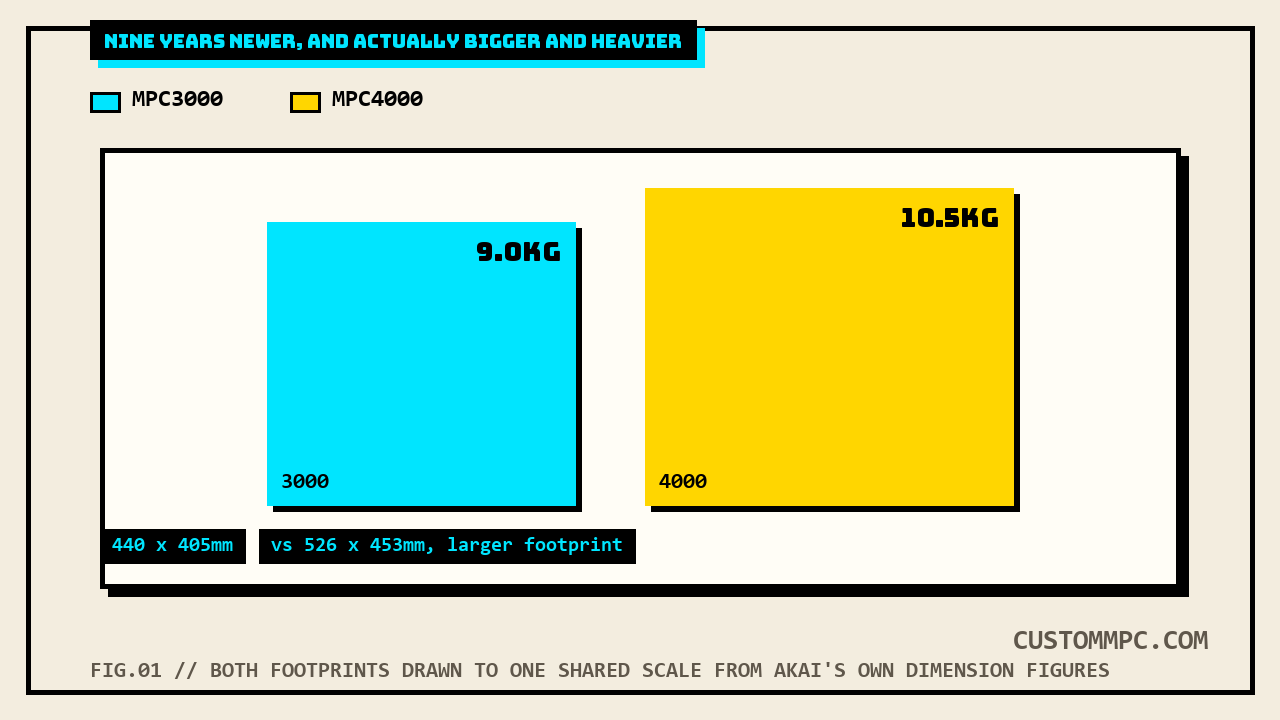
The 4000 is bigger in every dimension and heavier than the 3000, a genuinely counterintuitive result for a machine built eight years later with a smaller, more integrated component landscape available to work with:
"Dimensions 526 (W) x 170 (H) x 453 (D) mm (with LCD tilted down) / Weight 10.5kg (without options)" (MPC4000). "Dimensions... 440 (W) x 121 (H) x 405 (D) mm / Weight... 9kg" (MPC3000).
The 4000's own dimension figure carries a qualifier the 3000's doesn't, "with LCD tilted down," meaning the tilting screen adds to the footprint when raised, a detail worth knowing before planning rack or desk space around the smaller number alone. Weight is stated "without options" on the 4000, so a unit with the IB-4D, IB-4ADT, and IB-48P boards installed weighs more than the spec-sheet figure.
The CPU row is a genuine documentation gap, disclosed rather than guessed. The 3000's own SPECIFICATIONS section names a CPU model directly: "CPU... V53/16 MHz." The 4000's equivalent section names none. But its service manual discloses something the 3000's never had reason to: a CPU Board Test Mode that runs by physically moving the 4000's CPU board into an Akai Z4/Z8 rack sampler chassis and loading that machine's OS onto it, confirming the 4000 and the Z4/Z8 rack samplers share the same core board design at the service level. The 3000, a decade earlier and built around a dedicated, non-modular design, has no equivalent cross-platform service note.
What never changed
As much signal here as in the differences.
- MIDI output channel count is identical. 64 channels across 4 independent ports on both machines, despite eight years and a doubled voice count elsewhere.
- 16 velocity- and pressure-sensitive pads, unchanged. Both machines document exactly 16 drum pads, the core physical interaction hasn't moved.
- Song mode's steps-per-song ceiling holds at 250. The 3000 allows 20 songs at 250 steps each, the 4000 allows 128 songs, more than six times as many, but the per-song step ceiling itself didn't change.
- Both got built-in SCSI, a real shared advance over the MPC60 before them, which needed a third-party Marion Systems board bolted on to get any SCSI capability at all.
Used market reality
Pricing on both machines is a small, honestly scattered sample rather than a clean market average, the same caveat this site's own buying guides for each machine carry individually. MPC3000 listings run roughly $1,811 for a standard Excellent-condition unit up to $2,306 for a serviced, bundled Mint-condition example, with the collector-driven MPC3000LE variant tracking a much wider range on top of that. MPC4000 listings run from roughly $500 for a bare working unit up past $2,100 for an excellent-condition example with extras, against a £2,299 launch price in 2002, meaning a stock 4000 has actually depreciated harder in percentage terms than the 3000 has, despite winning most of the raw spec comparison above. That price gap runs the opposite direction from the 2000XL-vs-3000 comparison on this site, where the smaller, later machine sold for less than the earlier flagship. Here the newer flagship is the cheaper one on the used market, and the reason tracks directly with the I/O section above: buyers have to price in the IB-4D and IB-48P boards separately to match what a stock 3000 already does out of the box, and that extra cost and complexity shows up as a discount on the base unit's own asking price.
Verdict
VERDICT
Buy the MPC4000 if the sound-engine numbers matter most to how you work: double the polyphony, higher sampling rates and bit depth, a sequencer with ten times the resolution, and 32 times the memory headroom, and you're willing to budget separately for the IB-4D and IB-48P boards if you need digital I/O or more than a stereo output. Buy the MPC3000 if S/PDIF and 8 individual outputs need to be standard on day one without sourcing extra boards, size and weight matter in your setup, or the specific cultural and collector weight of the 3000's own run of records is part of what you're actually paying for. Either way, "flagship successor" doesn't mean every number moved the 4000's way, know which specific I/O a listed unit actually has installed before assuming the newer, more capable machine also arrived more connected out of the box.
Buying either one used? The MPC3000 buying guide and the MPC4000 buying guide cover the full physical-condition checklist this article doesn't repeat. And if the MPC2000XL versus MPC3000 comparison is more your speed, we've covered that pairing too.